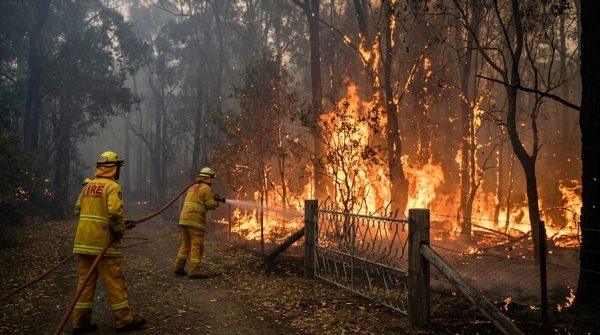
Spring in the northern United States is shaping up to be a season of heightened wildfire danger, and the culprit is a familiar name: El Niño. But this time, the risk is shifting to regions that don't usually brace for early-season blazes. New research from federal scientists ties the warming of the Pacific Ocean to drier winters and faster-drying vegetation across the northern tier of the country, setting the stage for a potentially active fire season.
The study, published in the Journal of Geophysical Research: Atmospheres, looked at nearly four decades of atmospheric data from nine geographic coordination centers. The team, led by NOAA scientist Andrew Hoell, analyzed satellite imagery, rainfall records, and evaporative demand—a measure of how quickly the atmosphere pulls moisture from the ground—between 1984 and 2022. Their findings establish a direct link between Pacific warming and rapid vegetation moisture loss, a key ingredient for fire spread.
Why the north is at risk
El Niño alters atmospheric circulation in ways that create high-pressure ridges over northern latitudes. These ridges block winter precipitation and accelerate evaporation, leaving forests and grasslands drier than usual by spring. "The combination of reduced snowpack and higher evaporative demand is a recipe for early-season fires," explains Hoell. "It's not a site-specific forecast, but it gives us a clear signal of where to focus resources."
The Climate Prediction Center's October outlooks, released on October 8 and 15, 2026, anticipate severe soil moisture deficits from January through March 2027. That means dense forest fuels in states like Montana, Idaho, and Wyoming will be primed to burn. Meanwhile, southern states may see heavier precipitation, a classic El Niño pattern that contrasts sharply with the northern drying.
Geographic vulnerability and coordination
The Northern Rockies operational territory—covering Montana, Idaho, and Wyoming—faces elevated spring fire risk, where mountainous terrain complicates containment. The Eastern Region, spanning 20 states across the Midwest and New England, also shows heightened vulnerability, especially in wildland-urban interfaces where communities meet forests. In contrast, the Great Basin, Rocky Mountain, and Southern sectors historically see reduced spring burn probabilities during El Niño, though wet cycles can later turn dense vegetation into hazardous fuel.
These operational zones are administrative hubs under the National Interagency Fire Center, pooling resources across federal, state, tribal, and local agencies. Their boundaries don't align with political borders, and impacts vary locally, so coordination is key.
For Latino communities across the West and Southwest, this shift in fire risk is a reminder that climate patterns are changing. While El Niño's rains have eased California wildfires in the past, they also bring new hazards, and the northern states are now in the crosshairs.
ENSO cycle and historical patterns
The study also examined the full ENSO cycle, including La Niña phases. Historical records show that La Niña elevates large fire probabilities in the South and Southwest during winter and spring, shifting risk toward Northern California by summer. This contrast underscores the importance of seasonal timing and regional susceptibility in emergency planning.
Forecasters project an 83% chance that current oceanic warming will reach strong intensity through 2027, driving multi-agency fire resource allocation. NOAA's October 2026 updates confirm the trend, providing operational intelligence up to a year in advance. But atmospheric scientists emphasize that these climate signals must be integrated with real-time weather observations.
For now, civil protection agencies will monitor drought trends and fuel moisture levels throughout the winter. The goal is to adjust threat levels and deploy suppression assets before the first sparks fly. As Hoell puts it, "We're not predicting a specific fire, but we're saying: be ready."
For those in the Latino diaspora, many of whom have family ties to fire-prone regions in México, Centroamérica, or the U.S. Southwest, this news hits close to home. The changing dynamics of El Niño are a shared experience across the Americas, from the stormy winters in Florida to the record waves on the California coast. Understanding these patterns is essential for protecting communities and livelihoods.
As spring approaches, the message from scientists is clear: the north should prepare for a fire season that may arrive earlier and with more intensity than in the past. And while El Niño is a natural phenomenon, its impacts are increasingly shaped by a warming climate, making preparedness more critical than ever.