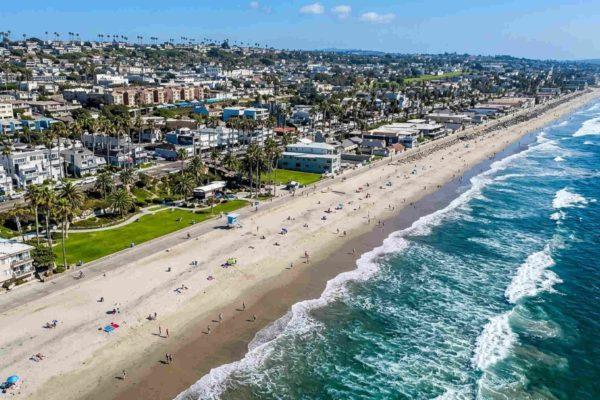
California's coastline is disappearing, and the latest state climate report delivers a sobering forecast: between 24% and 75% of the Golden State's beaches could be swallowed by the ocean by the year 2100. The Fifth Climate Change Assessment, released this year, paints a stark picture of rising seas and intensifying wave action eating away at the sandy buffers that protect coastal communities from San Diego to Humboldt County.
For many Latinos in California, this isn't just an abstract climate statistic. From the working-class beach towns of Baja California to the bustling shores of Long Beach and Santa Monica, the ocean is both a livelihood and a cultural anchor. The erosion crisis is already reshaping neighborhoods, threatening homes, and forcing tough choices about how to hold back the sea.
Real estate on the edge
The damage is no longer a distant warning. In Long Beach, a series of powerful storms—Hurricanes Marie and Polo, along with Tropical Storm Rachel—battered the peninsula in recent years, cracking the foundations of luxury homes and leaving them condemned. Properties once valued near $5 million have been reduced to the value of the land they sit on, a devastating blow for owners and a stark reminder of the ocean's power.
Statewide, analysts estimate that coastal erosion already endangers between $6.6 billion and $24.7 billion in real estate. That's not just a loss for wealthy homeowners; it's a hit to local tax bases, tourism revenue, and the communities that depend on the coast. For many Latino families who have lived in these areas for generations, the threat is existential.
Fighting the sea with sand and steel
In response, cities are pouring millions into emergency projects. Long Beach alone spends over $1 million annually to pump artificial sand onto its beaches, and has advanced an $11.4 million dredging operation to slow the shoreline's retreat. But experts warn that these efforts may be a losing battle.
Seawalls and rock revetments, designed to protect buildings, often accelerate sand loss by reflecting wave energy and trapping beaches between the water and the wall. The result is a narrowing beach that eventually disappears entirely, leaving the coast even more vulnerable. As San Clemente's recent string of disasters shows, erosion is not just a future threat—it's a present-day crisis.
Some communities are exploring more natural solutions, like allowing dunes to migrate inland or relocating structures. But these approaches are costly and politically difficult, especially in areas with dense development. The tension between protecting property and preserving the beach is a central dilemma of California's climate future.
A broader climate picture
The erosion crisis is part of a larger pattern of climate disruption affecting the Pacific coast. Super El Niño events are projected to bring record sea level rise, while heat-driven evaporation is worsening droughts. These forces compound the pressure on coastal ecosystems and communities.
For Latinos across the state, the stakes are personal. Many have deep roots in coastal towns, from the fishing villages of Baja to the surf culture of Southern California. The loss of beaches would not only erase homes and businesses but also a way of life.
As California grapples with this crisis, the choices made in the coming decades will determine whether the state's iconic coastline survives for future generations. The ocean is rising, and the time to act is now.