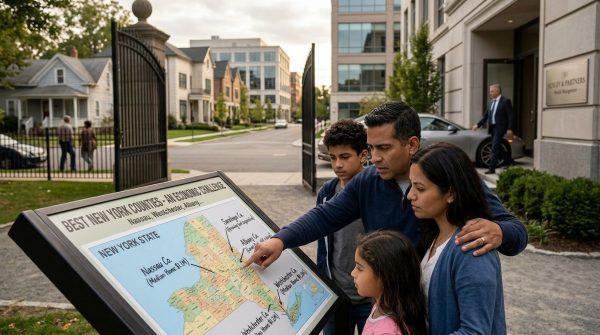
For years, counties like Nassau and Westchester have been the gold standard for New York living: top public schools, safe neighborhoods, and easy access to Manhattan. But as of 2026, these same areas are becoming increasingly inaccessible for working-class families, including many in the Latino community who have long called these suburbs home.
The cost of living across New York has climbed sharply, driven by sustained inflation, limited housing inventory, and intense real estate demand. What was once a reasonable goal—buying a home in a highly rated county—now feels like a distant dream for a significant portion of the population. According to recent data, even counties with strong job markets and community services, such as Albany and Saratoga, are feeling the pressure.
The Affordability Gap Widens
Nassau and Westchester consistently rank among the best places to live in New York, thanks to their excellent public school systems and proximity to New York City. But the price of admission is steep. Median home prices in these counties now exceed $600,000, and property taxes are among the highest in the nation. For a family earning the median income in the region, that translates to a housing cost burden that many simply cannot sustain.
Tompkins County, home to Cornell University in Ithaca, offers a vibrant cultural and educational ecosystem. Yet even there, property values have risen sharply, pushing rental and purchase prices beyond what many local workers can afford. The pattern is clear: the best-rated areas are becoming enclaves for the wealthy, while working families are pushed to more affordable—but often less resourced—regions.
This trend is not accidental. Economists point to a combination of factors: limited new construction, zoning restrictions that favor single-family homes, and a surge in demand from higher-income buyers. The result is a socioeconomic polarization that leaves many New Yorkers, including Latino families who have historically settled in these suburbs, with fewer options.
Global Wealth Migration and Local Realities
While New York's top counties struggle with affordability, wealthy individuals are increasingly mobile. According to Henley & Partners, a global residency and citizenship planning firm, cities like Scottsdale, West Palm Beach, the Bay Area, Miami, Washington D.C., and Austin are among the world's fastest-growing wealth hubs as of 2024. These “safe havens” offer favorable tax regimes, top-tier education and healthcare, and a high quality of life—factors that also appeal to high-net-worth individuals moving from abroad.
For Latino families in New York, the contrast is stark. While the wealthy can choose among global destinations, many working families are left to navigate a local market where even the best counties are slipping out of reach. As recent projections show, by 2028 several U.S. cities could become unaffordable for Latino families on stagnant incomes, a trend that mirrors what is already happening in New York's top counties.
Some families are already voting with their feet. In Union City, New Jersey, just across the Hudson, young families are fleeing as costs and amenities fail to keep pace. Similar dynamics are playing out in New York's suburbs, where the promise of a better life is increasingly tied to a high income.
The situation is not hopeless, but it demands a clear-eyed assessment. For Latino families who value community, good schools, and safety, the best New York counties remain aspirational. But without significant policy changes—such as increased housing supply, rent stabilization, or targeted tax relief—the gap between aspiration and reality will only grow.