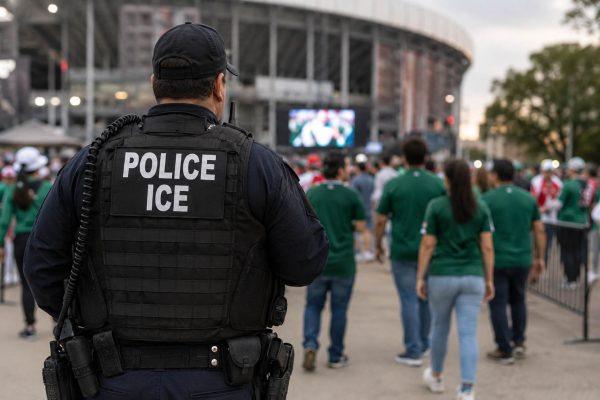
The 2026 FIFA World Cup, set to kick off across North America, was supposed to be a celebration of soccer and culture. But for many Latino families in the United States, the tournament now carries a heavy weight of anxiety. The Department of Homeland Security has confirmed that Immigration and Customs Enforcement (ICE) agents will have an active presence at matches, a decision that has ignited fierce controversy and legal battles.
Secretary Markwayne Mullin stated that ICE personnel will focus on venue security, counterterrorism, and event infrastructure—not on immigration enforcement. Yet for communities in cities like Houston, Los Angeles, and New York, where millions of Latino residents live and work, the line between security and deportation feels dangerously thin. “We’re being told not to worry, but we’ve heard that before,” said a community organizer in East Los Angeles.
Stadium Workers Push Back
The backlash isn’t limited to advocacy groups. Stadium employees, many of whom are immigrants or children of immigrants, have voiced strong opposition to working under the watch of ICE agents. In several host cities, unions representing concession workers, janitors, and security staff have issued formal strike threats. If these walkouts materialize, they could disrupt operations at venues like SoFi Stadium in Los Angeles, which is set to host eight matches including the U.S. vs. Paraguay. SoFi Stadium's World Cup schedule already includes high-stakes games, and a strike could throw logistics into chaos.
Labor leaders argue that the presence of ICE creates a hostile work environment. “Our members are afraid to even show up,” said a union representative from Houston, where NRG Park has entered full lockdown for the tournament. The tension is palpable, and it’s not just about safety—it’s about dignity.
Know Your Rights: A Community Response
In response to the federal announcement, immigrant advocacy groups have mobilized quickly. The New York Immigration Coalition, led by Murad Awawdeh, has been distributing educational toolkits at community centers and online. Speaking on WABC TV’s Tiempo with journalist Tanya Rivero, Awawdeh emphasized that fans and families must understand their constitutional protections. “You have the right to remain silent. You have the right to refuse entry to your home without a warrant. These are not just words—they are shields,” he said.
Similar campaigns are underway in Chicago, Miami, and San Diego, where organizers are training volunteers to assist Spanish-speaking attendees. The goal is to ensure that the World Cup remains a space for joy, not fear. “We want people to cheer for their teams, not worry about being detained,” said a volunteer in Pilsen, a predominantly Mexican neighborhood in Chicago.
The legal challenges are also mounting. Civil rights groups have filed lawsuits arguing that the deployment violates due process and creates a chilling effect on immigrant communities. Meanwhile, the 2026 World Cup schedule includes matches in cities with large Latino populations, from Mexico City to Guadalajara, where fans are watching the U.S. developments closely.
For many, this is not just a policy debate—it’s personal. The tournament will feature stars like Argentina’s Emiliano Martínez, who recently confirmed he’ll be fit for the opener. Martínez’s recovery is a bright spot, but the shadow of ICE looms large. As the opening matches approach, the question remains: Can the World Cup be a unifying force when so many feel targeted?