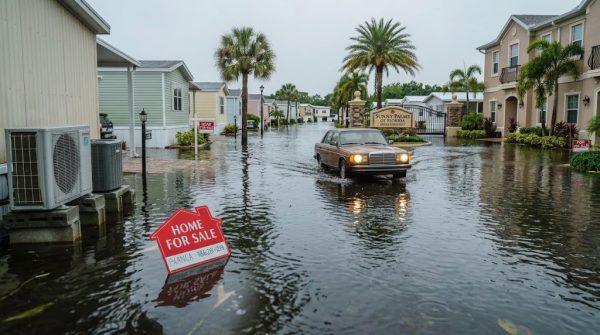
When Floridians went to the polls, they sent a clear message: they wanted relief from soaring property taxes. Amendment 3, which passed with 62% support, will gradually raise the homestead exemption from $50,000 to $250,000 by 2028. But that victory for homeowners has local officials across the state bracing for a fiscal storm of their own.
Across the low-lying coasts of South Florida, where the Atlantic and the Gulf of Mexico creep ever closer, the money that keeps the water at bay is drying up. The tax cuts will strip hundreds of millions of dollars from municipal budgets that fund the pumps, pipes, and seawalls that protect neighborhoods from flooding. And as sea levels rise, the stakes have never been higher.
A budget crunch in the Sunshine State
At the annual summit of the Southeast Florida Climate Compact, regional leaders gathered to confront a sobering reality. Broward County Commissioner Steve Geller warned that the revenue losses will degrade essential services and leave coastal communities dangerously exposed. His concerns are backed by numbers: consulting firm Brizaga projects Broward will face a $333 million budget deficit by 2028.
Miami-Dade County is staring down an even larger hole. County budget analysts estimate the tax cuts will eliminate $700 million annually—about 20% of the property tax revenue the county collects. Commissioner Raquel Regalado tried to strike a more measured tone, cautioning against catastrophic predictions, but the math is hard to ignore.
The pain extends beyond the big counties. Monroe County, home to the Florida Keys, expects a $10 million loss that could derail a $4.7 million plan to raise roads in vulnerable coastal neighborhoods. Even the South Florida Water Management District, which operates a 70-year-old drainage network serving 9 million residents, faces an $110 million budget gap by 2031.
These cuts come at a time when the region is already grappling with the effects of a changing climate. As El Niño intensifies flooding risks, the need for robust infrastructure has never been more urgent.
Matching funds and federal dollars at risk
Local governments often rely on state and federal grants to fund large-scale stormwater projects. But many of those grants require a 50/50 local match. With property tax revenue shrinking, cities and counties may struggle to come up with their share, putting millions in federal dollars for Everglades restoration and other resilience efforts in jeopardy.
Irela Bagué, a former governing board member of the South Florida Water Management District, emphasized that without local matching funds, the region could lose out on critical federal investments. “We’re talking about the very systems that keep our communities dry,” she said.
In Monroe County, officials have already started exploring alternative funding sources, including special assessments on homeowners, after state lawmakers rejected a proposed tourist tax hike. It’s a sign of the creative—and sometimes unpopular—measures local governments may have to consider as they scramble to fill budget gaps.
What’s next for Florida’s infrastructure?
State legislators are set to convene next year to hammer out the implementation details of Amendment 3. Meanwhile, municipal finance officers are analyzing new revenue models to keep capital projects on track. The challenge is immense: sustained population growth and rising seas demand continuous investment in high-capacity pumps and elevated roadways, even as the tax base shrinks.
Some see a silver lining in the state’s resilience grant programs. Governor Ron DeSantis has championed over $1 billion in state grants for local stormwater projects. But that funding may not be enough to offset the long-term revenue losses. And a legislative mandate to study the full elimination of non-homestead taxes adds another layer of uncertainty.
For now, local leaders are left to navigate a precarious balancing act. They must protect public safety and infrastructure while respecting the will of voters who demanded tax relief. As Miami’s property tax overhaul shows, the savings for homeowners could come at a cost to renters and the broader community.
The coming years will test Florida’s ability to adapt. With the clock ticking on climate change, the question isn’t just who will pay for flood control—it’s whether the state can afford to wait.