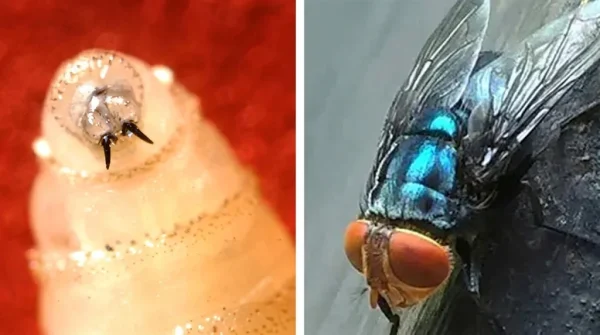
Three years after the New World screwworm slipped past Panama's Darien Gap, the United States is scrambling to contain a flesh-eating parasite that federal officials admit could have been stopped sooner. The crisis, which has already infected thousands of animals and people across Mexico and Central America, has exposed a glaring hole in the country's biosecurity: there is still no domestic facility capable of producing the sterile flies needed to halt the parasite's spread.
The screwworm, a fly larva that burrows into living tissue, was eradicated from the U.S. in the 1960s thanks to a massive sterile insect release program. But in February 2023, Panamanian authorities recorded nearly 800 cases in the Darien Gap, the last natural barrier before Central America. By April of that year, the Panama-United States Commission for the Eradication and Prevention of the Screwworm voted to ramp up production from 20 million to 100 million sterile flies per week. Panama declared a health emergency in July 2023 and tightened livestock transit controls, but the parasite kept moving north.
Despite early warnings, the former administration only announced $110 million in additional funding in December 2023—money that arrived as the screwworm was already advancing. The U.S. Department of Agriculture didn't seriously discuss building a domestic sterile fly facility until November 2024, a delay that experts say gave the parasite a critical head start.
Infrastructure gaps and a border closure
In May 2025, the presidential administration ordered a 15-month closure of the southern border, a move that disrupted billions in bilateral trade. Meanwhile, a $610 million contract was awarded to M.A. Mortenson in March 2026 to accelerate construction at Moore Air Base in Edinburg, Texas, with an additional $250 million from the Department of Defense. The facility is now slated to open on April 1, 2027—more than four years after the first outbreak in Panama.
But even with the new plant, the U.S. will remain dependent on facilities in Panama and Metapa, which together produce roughly 150 million sterile flies per week. That's far below the 500 million minimum needed to effectively combat the parasite, a number that matches the output during the successful 1960s eradication campaign. As Texas A&M entomologist Sonja Swiger explains, the sterile insect technique works by releasing sterilized males that mate with wild females, preventing eggs from hatching. Without enough sterile flies, the strategy simply doesn't work.
“A single female screwworm can lay up to 3,000 eggs,” Swiger noted. “If you don't have enough sterile males to outcompete the wild ones, the population explodes.”
Public health and economic fallout
The Centers for Disease Control and Prevention has recorded over 209,400 animal cases and more than 2,800 human infections across Mexico and Central America, including a confirmed case in August 2025 of a U.S. citizen who contracted the parasite after traveling to El Salvador. USDA spokesperson Nancy McNiff insists the agency has acted with urgency, but experts say the public health guidance remains thin: use insect repellent, keep wounds covered, and avoid contact with livestock in endemic areas.
The economic toll is mounting. Border closures and supply shortages have hit livestock and agricultural sectors hard, and the recent detection of the screwworm in a Texas elk has expanded surveillance efforts. As the U.S. reopens its border in 2026, agricultural authorities are closely monitoring livestock imports, with 120 official animal records now on file nationwide.
Specialists estimate that definitive containment will require a decade of continuous aerial releases of sterile flies. That means the U.S. must not only build the Texas facility but also maintain a robust production pipeline. The rapid growth of Florida's agricultural and residential areas adds another layer of vulnerability, as the parasite could easily spread to new regions.
For now, the message from experts is clear: biosecurity is not a luxury but a necessity. The U.S. had three years to prepare, and the missing defense—a domestic sterile fly facility—remains a critical gap. As one official put it, “We're playing catch-up, and the parasite isn't waiting.”
For Latino communities across the borderlands, this is not just a livestock issue. It's a public health and economic issue that affects families, farmers, and entire regions. The resilience of Latino businesses in places like Boyle Heights shows how communities adapt, but the screwworm threat demands a coordinated, well-funded response that respects the interconnectedness of the Americas.