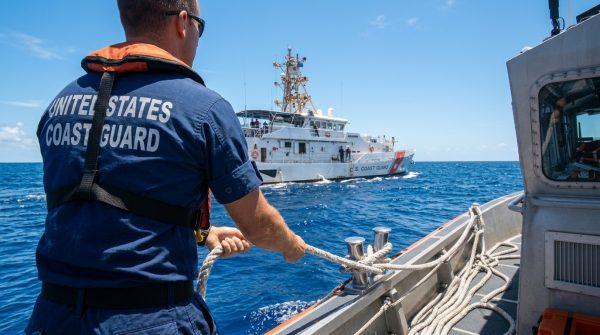
In the early hours of October 16, 2026, a routine patrol turned into a life-or-death operation 140 miles off the coast of Baja California. A boat carrying more than two dozen people had capsized, scattering passengers into the cold, black waters of the Pacific. The U.S. Coast Guard, responding from Air Station Ventura, deployed a helicopter with rescue swimmer Josh Law aboard. What followed was a two-hour ordeal that would test his skill, endurance, and resolve.
A leap into the dark
Law was lowered from the helicopter into 6-to-8-foot swells, with rotor wash creating a deafening roar and blinding spray. “I couldn’t hear anything over the noise or see anything in the dark,” he later told the AP. Guided only by the aircraft’s searchlight, he began swimming toward the blinking emergency lights attached to life jackets scattered across the water. Some survivors clung to each other, others to buoys or pieces of wreckage.
Using the buddy-tow technique, Law flipped each victim onto their back and towed them through the waves to the rescue basket, one at a time. “With one hand I was holding the survivor. With the other, I was signaling the helicopter and operating the device,” he recounted. The physical toll was immense: water breached his dry suit, filling it to his knees, adding weight to every stroke. Yet he kept going, driven by the thought that “what I was experiencing was nothing compared to what they were at that point.”
Shark bites and a race to San Diego
Once the survivors were hoisted aboard, the helicopter headed for San Diego, but the danger wasn’t over. Law noticed three patients with severe bleeding—wounds consistent with shark bites, likely from encounters near Guadalupe Island, a known hotspot for great whites. He administered emergency trauma care mid-flight, stabilizing them until they reached the hospital. In San Diego, city spokesperson Matt Hoffman confirmed that two patients remained in critical condition, while three were admitted to Scripps Mercy Hospital and three others were evaluated at Scripps Memorial Hospital La Jolla before being released.
The rescue was a testament to the Coast Guard’s training and the crew’s coordination, but it also underscored the perils of the sea. As Santiago Tamburini, a local maritime expert, put it, “The sea is unforgiving in that area.”
An investigation into the vessel’s origins
While the rescue saved 16 lives, 11 others were never found. The U.S. Coast Guard, U.S. Navy, and Mexican Navy conducted a three-day search covering 2,400 square miles over 89 hours before suspending active recovery efforts. The Mexican Consulate in San Diego provided consular assistance to all survivors, all of whom were Mexican citizens. U.S. Customs and Border Protection officers processed them at local hospitals, and nearly half have since returned to Mexico.
Federal authorities have launched a formal inquiry into the vessel’s origins, destination, and whether human smuggling was involved. The route, often used by fishermen and recreational boats, has also become a corridor for smugglers. The investigation will determine if the boat suffered mechanical failure, lost its way, or drifted into open sea. This incident echoes other recent maritime challenges along the Pacific coast, such as the massive waves that hit the Amtrak Pacific Surfliner and the broader threat of Super El Niño to coastal communities.
For Law, the mission was a blur of adrenaline and exhaustion. “I just had to keep that in mind,” he said, referring to the survivors’ suffering. His actions, along with the entire Coast Guard team, turned a potential tragedy into a story of heroism—one that highlights the dangers faced by those who risk the crossing and the dedication of those who answer the call.