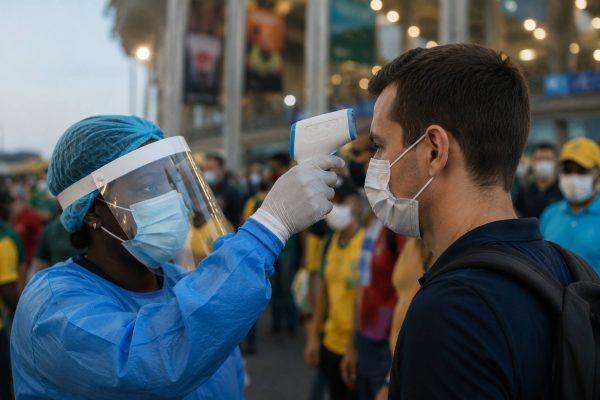
As the 2026 FIFA World Cup approaches, bringing over five million ticket holders to 39 days of matches across the United States, Mexico, and Canada, a troubling gap has emerged in the host nation’s preparedness. The U.S. federal government committed a historic $625 million to law enforcement and physical security, but epidemiologists note that zero direct funding was allocated to public health infrastructure. This imbalance has local health officials and infectious disease specialists sounding alarms about the potential for super spreader events in one of the highest-density mass gatherings in modern American history.
Security Funding, Health Neglect
The Federal Emergency Management Agency (FEMA) confirmed that its $625 million grant system is strictly limited to background screenings, cyber defense, and police response. Municipal bio-safety networks, local hospitals, and food safety departments are left to absorb international health risks without supplementary federal capital. This operational gap is especially concerning given the volume of international transit and the diverse pathogens that could enter packed stadium infrastructure.
In Kansas City, a critical host hub managing six World Cup fixtures and four national team base camps, epidemiologists detected measles fragments in municipal wastewater streams. This leading data indicator typically shadows emergency room patient surges by five to seven days, raising red flags about the region’s ability to respond. Texas, anchored by primary host venues in Dallas and Houston, registered failing scores on the preparedness charts issued by Trust for America’s Health, while federal airborne bio-terrorism detection platforms like BioWatch remain only partially integrated.
Biocontainment Shortfalls and Super Spreader Liabilities
Infectious disease specialists emphasize that current geopolitical health metrics—including active Ebola flare-ups in the Democratic Republic of the Congo and hantavirus tracking in South America—heighten the entry probability for imported viral pathogens. Institutional simulation models show that Middle East Respiratory Syndrome (MERS) represents a severe super spreader liability within local emergency rooms because standard rapid diagnostic panels fail to identify the virus. The national clinical safety margin is narrow: the United States holds only 26 specialized biocontainment beds across 13 regional treatment networks, meaning local medical centers lack the surge capacity required to isolate high-consequence respiratory outbreaks.
These vulnerabilities are compounded by the absence of a unified, centralized sanitary command chain across the three host nations. Without coordinated health data sharing, the risk of undetected transmission chains grows. For Latino communities in cities like Los Angeles, Houston, and New York, where many residents work in hospitality and service industries tied to the World Cup, the stakes are especially high. New York and New Jersey have launched massive health operations to address these concerns, but the lack of federal support leaves local systems stretched.
Unofficial Fan Camps and Sanitation Risks
Hyper-inflated hotel rates have forced thousands of incoming soccer fans to establish unapproved, informal campsites in vacant urban spaces. Municipal health directors warn that the absence of structured sanitation pipelines in these zones mirrors conditions that drive hepatitis A outbreaks. The near impossibility of executing clinical contact tracing or quarantine protocols among transient populations adds another layer of risk. In Texas, where NRG parking chaos and ICE presence have already sparked community concerns, these informal camps could become hotspots for disease spread.
Academic and Military Interventions
Faced with early institutional coordination delays from the Centers for Disease Control (CDC), higher education entities and the U.S. military executed independent intervention strategies. Georgetown University developed a private Health Security Operations Center (HSOC) to aggregate multi-sector medical data, while the Armed Forces Health Surveillance Division drafted international import risk models that federal civilian agencies never requested. These ad hoc efforts, while innovative, highlight the systemic gaps in preparedness.
For the Latino diaspora, many of whom will travel from across the Americas to attend matches or host visiting fans, the lack of a coordinated health response is deeply concerning. The World Cup is a celebration of culture and sport, but without robust public health infrastructure, it could also become a vector for outbreaks. As Central Park prepares to host free public viewings for the final, the contrast between celebratory plans and health preparedness is stark.
The 2026 World Cup should be a moment of pride for the Americas, but it demands a serious re-evaluation of priorities. Security is essential, but so is the health of the millions who will gather to cheer on their teams. Without federal investment in bio-safety, the risks of a public health crisis loom large.