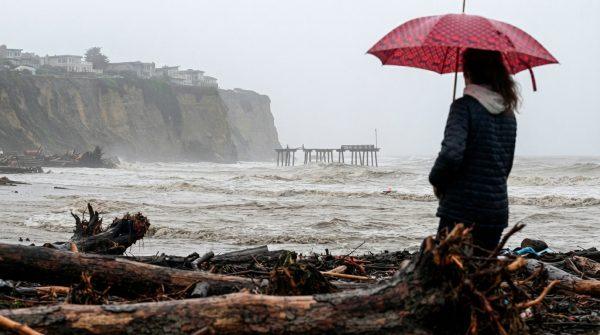
This winter, the familiar rhythms of the season are being rewritten across the American Southwest. A powerful Super El Niño, driven by unusually warm waters in the Pacific, is expected to bring a volatile mix of storms, precipitation, and temperature swings to a region that stretches from California to Arizona and beyond. For the millions of people who call this area home—many of them part of the broader Latino community with deep roots in the land—the changes are more than a weather forecast; they are a reminder of how closely life here is tied to the sky.
What's driving the shift?
At the heart of this phenomenon is the Pacific jet stream, which is being pushed southward by ocean temperatures that are running more than 2.5 degrees Celsius above normal. That shift is steering storm systems toward southern California, Arizona, southern Nevada, and southeastern Utah, while leaving northern areas with less predictable conditions. The result is a winter that could be dramatically wetter in some places and drier in others, with rainfall totals varying by as much as 50% from one valley to the next.
Meteorologists are quick to point out that this is not a uniform event. "Every Super El Niño has its own personality," says Dr. Elena Ramírez, a climate scientist at the University of California, Davis. "We're seeing a lot of variability, and that makes planning especially challenging." Indeed, the North American Multi-Model Ensemble, a key forecasting tool, projects wetter-than-normal conditions across more than 60% of the Southwest, but also shows drier trends for parts of northern Utah and Nevada. Temperature forecasts are equally split, with different models disagreeing on how warm or cold the coming months will be.
Water managers on alert
For water resource managers, this uncertainty is a serious concern. Reservoirs across the region hold more than 50 million acre-feet of water, and the balance between flood risk and water supply is delicate. "We're preparing for both extremes," says Miguel Torres, a hydrologist with the California Department of Water Resources. "Heavy rain could cause flooding, but a dry spell could leave us short next summer."
The stakes are high for communities that depend on this water for agriculture, drinking, and recreation. In the Central Valley, where many Latino farmworkers live and work, the winter snowpack is a lifeline. The Central Sierra Snow Laboratory, which has been tracking snow for over 70 years, notes that historical warm events have produced wildly different outcomes—sometimes above-average snow, sometimes far below. "We can't assume anything," says Torres.
Preparing for the worst
Across the region, emergency responders are not waiting for the first storm to hit. More than 450 specialized units are on standby, and officials are inspecting drainage systems that span over 3,500 kilometers. In California, new regulations are also taking shape to protect residents, including a rule that requires HOAs to fix essential utilities within 14 days—a measure that could prove vital during winter outages.
Meanwhile, the state is also grappling with other climate-related challenges, such as new safety rules for AI models, but the immediate focus is on the weather. "We're monitoring every river basin, every snow sensor," says Torres. "Our goal is to keep people safe and ensure that when the water comes, we're ready."
For the Latino communities that have long thrived in this region, the Super El Niño is a reminder of the deep connection between the land and the people. From the farmlands of the Imperial Valley to the urban neighborhoods of Phoenix, the winter ahead will test resilience. But as always, the response is rooted in community—neighbors helping neighbors, and a shared understanding that the weather, no matter how wild, is part of life here.
As the season unfolds, experts will continue to refine their forecasts, but the message is clear: be prepared for anything. Whether it's a deluge in Los Angeles or a dry spell in Salt Lake City, the Southwest is in for a winter that defies easy prediction.