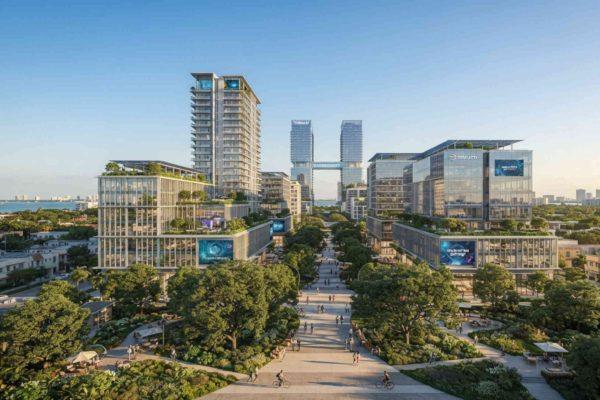
In the heart of Little Haiti, a neighborhood rich with Caribbean culture and history, a bold urban vision is taking shape. The Magic City Innovation District, led by investor Bob Zangrillo and Plaza Equity Partners, aims to position Miami as a global center for artificial intelligence, asset management, and venture capital. More than a decade after initial plans were floated, the project now aligns with the digital age's demands, proposing a strategic ecosystem that integrates luxury residences, corporate headquarters, and entertainment spaces near Biscayne Bay and Miami International Airport.
This isn't just another real estate development. The district spans nearly 17 acres and will feature 7.8 million square feet of construction. At its core are 2,630 state-of-the-art rental apartments and over 2.2 million square feet of corporate offices designed to house the most influential tech companies. A 432-room hotel and more than 520,000 square feet of retail and dining space will ensure the area functions as a live-work-play hub. The goal is to attract global talent to Miami through a modern, highly connected design that integrates artificial intelligence into everyday life.
Phased Development with a Green Commitment
The project will roll out in phases, starting with the Dragon Global AI technology office campus and the Sixty Uptown residential tower. Next comes Station M, a tech accelerator and incubator inspired by Paris's Station F. But beyond the smart buildings and AI focus, the design emphasizes nature. A central axis called the "grand public promenade" will preserve century-old oak trees, and at least 21% of the total land area will remain as open green spaces for residents and visitors.
This commitment to sustainability is notable in a city where rapid development often comes at the expense of green areas. The district aims to be a model for how urban growth can coexist with environmental stewardship. For Miami's Latino community, many of whom have deep roots in Little Haiti and surrounding neighborhoods, the project raises questions about displacement and affordability. While the developers promise economic opportunities, the influx of luxury housing and corporate offices could accelerate gentrification in an area already feeling the pressure of rising costs.
Miami has long been a magnet for wealth migration, as seen in the exodus from California driven by high taxes. The Magic City Innovation District is part of a broader trend transforming the city's skyline and economy. Yet, it also highlights the tension between progress and preservation. For every new tech campus, there's a risk that the cultural fabric that makes Miami unique—its cubanidad, its Haitian rhythms, its Venezuelan arepas—gets diluted.
The district's location in Little Haiti is particularly symbolic. This neighborhood has been a sanctuary for Haitian immigrants and their descendants, a place where Kreyòl is spoken on street corners and kompa music fills the air. As the city courts AI giants and venture capitalists, it must also reckon with the communities that have long called this land home. The developers have promised community benefits, but details remain sparse. Local activists have voiced concerns, drawing parallels to other Miami projects that have displaced residents, like the abandoned yachts that symbolize wealth inequality in Biscayne Bay.
Still, the potential is undeniable. Miami has already become a hub for Latin American tech entrepreneurs, and a dedicated AI district could accelerate that trend. The city's proximity to Latin America, its multilingual workforce, and its vibrant culture make it an attractive alternative to Silicon Valley. If the Magic City Innovation District delivers on its promises, it could become a model for how cities can embrace innovation without losing their soul. But the proof will be in the execution—and in whether the benefits reach beyond the boardrooms and into the neighborhoods that make Miami the Magic City.