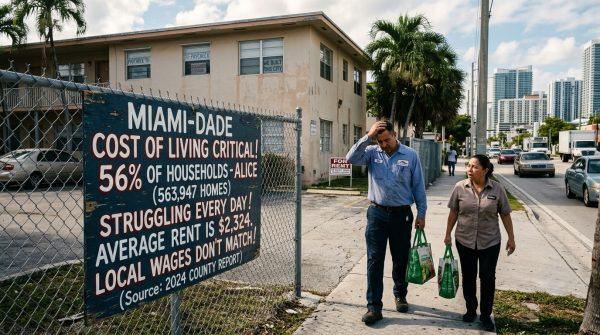
Miami-Dade County has long been a beacon for Latino families seeking opportunity, but the dream of stability is slipping away for hundreds of thousands of residents. A new analysis reveals that over half of the county's households—563,947, or 56%—are living in a state of constant financial precarity. These are not unemployed individuals; they are the working backbone of the community: cashiers, cooks, construction workers, and cleaners. Yet, despite holding jobs, they fall into the ALICE category—Asset Limited, Income Constrained, Employed—meaning they earn too much to qualify for public assistance but too little to save or handle emergencies.
The Numbers Behind the Squeeze
The gap between wages and the cost of living has become a chasm. According to data from the Bureau of Labor Statistics, the average rent for a two-bedroom apartment in Miami-Dade soared from $1,454 in 2019 to $2,324 in 2024—a jump of over 60%. For a family of four, the estimated annual cost of living now exceeds $114,480, a figure that dwarfs the income potential of many common occupations. Housing, childcare, food, and gasoline have all risen far faster than paychecks, leaving families with no room to breathe.
This economic vulnerability is not just a statistic; it is reshaping the county's demographics. Between mid-2024 and 2025, nearly 10,000 residents packed up and left Miami-Dade, seeking more affordable horizons. This exodus of working-age people is not merely a shift in population—it erodes the very workforce that keeps the region running. As one local expert noted, the flight of essential workers threatens the long-term sustainability of basic services, from restaurants to construction sites.
Who Is Hit Hardest?
The burden falls disproportionately on single-parent households and young adults under 25, who face increasingly steep barriers to entering the housing market. A staggering 81% of residents report high levels of financial stress, placing Miami-Dade among the most inflation-impacted areas in the nation. Many of these workers find themselves in a cruel limbo: they are deemed "too wealthy" for food stamps or rental assistance, yet "too poor" to afford a decent apartment. This paradox is a direct result of a system where wages have not kept pace with the cost of essentials.
For Latino families, who make up a significant portion of the county's workforce, the stakes are especially high. The dream of upward mobility—central to the immigrant experience—is being replaced by a daily grind of survival. As one community leader put it, "People are choosing between paying rent and buying groceries. That's not a choice anyone should have to make."
A Crisis of Regional Stability
The situation demands more than temporary fixes. Experts argue that Miami-Dade must undergo a deep reevaluation of how wages are structured in relation to the housing market. Prioritizing accessible housing policies could curb the departure of critical workers. Without such changes, the county risks losing not only its labor force but also its competitive edge. Similar trends are playing out in other parts of the country—Union City's young families flee as costs and amenities fail to keep pace, and by 2028, these US cities could be out of reach for Latino families on stagnant incomes.
The financial stress experienced by thousands of families is a symptom of a structural failure. The migration of residents is a clear indicator that the region's competitiveness is at risk due to the relentless climb of the Miami-Dade cost of living. Local leaders face an urgent challenge: to transform this reality before the flight of talent and labor becomes a permanent crisis. The future stability of the county depends not only on commercial growth but on its ability to offer dignified living conditions to those who build this city every day. Reaching a balance where employment is synonymous with financial security remains the most pressing challenge to mitigate the persistent economic vulnerability facing the region.
For those who remain, the struggle continues. But as more families pack their bags, the question looms: How long can Miami-Dade sustain itself if the people who make it run can no longer afford to call it home?