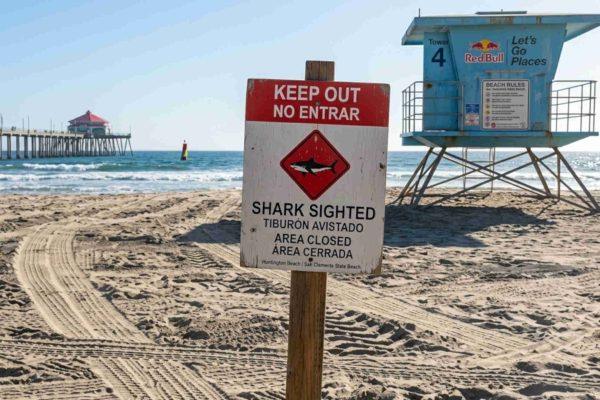
Huntington Beach, a beloved stretch of Southern California coastline, saw a two-mile section closed to ocean access on [date] after a foilboard surfer reported a white shark circling just 90 yards from shore. The alert, deemed credible by local authorities, triggered an immediate response from the Huntington Beach Fire Department and Marine Safety Division, who ordered a preventive closure between Seapoint Street and the municipal pier.
While beachgoers could still walk the sand, swimming, surfing, and other water activities were suspended as a precaution. The surfer described the shark as roughly ten feet in length, and its circular swimming pattern was classified by lifeguards as aggressive behavior, prompting a full-scale monitoring operation.
Drones and watercraft join the search
Marine Safety Battalion Chief Derek Peters confirmed that rescue teams deployed aerial drones, personal watercraft, and specialized rescue boats to scan the area. Despite an intensive search, they did not independently spot the shark. Still, officials kept the closure in place to ensure public safety, a decision that aligns with similar precautions taken earlier this year along California's coast.
“We take every report seriously, especially when it involves a white shark near swimmers,” Peters said. “The closure is a precautionary measure, and we’ll reopen the water as soon as we’re confident it’s safe.”
This incident echoes a broader pattern of increased shark sightings along the Pacific coast, which scientists attribute to warming ocean temperatures and shifting migratory routes. The El Niño-driven changes are not only bringing tropical fish to California waters but also altering the behavior of apex predators like the white shark.
El Niño and the science behind the sightings
Professor Chris Lowe, director of the Shark Lab at California State University, Long Beach, explained that the shark could be an adult searching for food or a juvenile displaced by El Niño currents. “These warm-water events push marine life northward, and sharks follow their prey,” Lowe said. “It’s a natural response to a changing ocean.”
Local families respected the closure, many using the time to watch the waves from the sand. But the incident underscores a growing reality for coastal communities: coexisting with marine life requires constant vigilance, especially as climate patterns shift.
For those tracking California's coastal challenges, this closure is part of a larger story of environmental change. From record El Niño waves to the struggles of the Scott River, the state's waters are in flux. Even as officials work to keep beaches safe, the ocean's rhythms remind us of its power.
As of now, the closure remains in effect, with updates expected from the Huntington Beach Marine Safety Division. For the Latino community that calls this coast home—many with roots in Baja California, México, and beyond—the ocean is both a livelihood and a source of recreation. This sighting is a reminder that respect for the sea is non-negotiable.