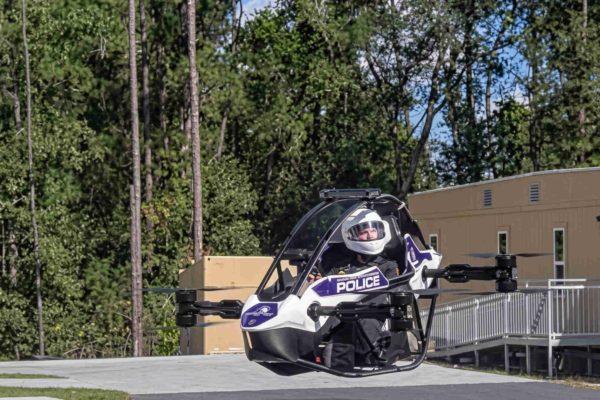
Florida's law enforcement is reaching for the skies with a new electric flying vehicle named Astro, a sleek, sci-fi-inspired machine that could one day transform how police respond to emergencies. But for now, the futuristic patrol car is more of a high-tech promise than a practical tool, grounded by battery limitations and regulatory red tape.
The Astro, developed in partnership with Florida Polytechnic University's security department, marks a first for U.S. policing: it's the first electric vertical takeoff and landing (eVTOL) prototype adopted by a police force. With eight motors and a top speed of over 100 kilometers per hour, it's designed to zip across difficult terrain or flooded zones—a capability that could be a game-changer in a state prone to hurricanes and sudden flooding.
Yet the excitement comes with a major catch: the battery only lasts about 20 minutes per charge. That means any aerial patrol would have to be lightning-fast, leaving little room for extended surveillance or prolonged response missions. For now, the Astro is more of a proof-of-concept than a full-fledged patrol vehicle.
Regulatory and Technical Roadblocks
Even if the battery were up to the task, the Federal Aviation Administration (FAA) hasn't yet granted the necessary permissions for Astro to fly in real emergency situations. The vehicle remains in a testing phase, awaiting official certification that could come before the end of the year, according to police leadership.
The Astro is based on the Jetson ONE, a single-seat eVTOL that costs $150,000. Its cabin is limited to a payload of 95 kilograms, meaning it can't carry a second passenger or heavy rescue gear. That's a significant constraint for police work, which often requires transporting equipment or personnel.
Despite these hurdles, the project is moving forward. Florida Polytechnic University's aerospace engineering students and faculty will use the carbon-fiber aircraft for virtual simulations and to optimize its energy performance, turning the Astro into a flying laboratory for future innovations.
What This Means for the Latino Community
For the young Latino community in Florida, many of whom are watching this technological leap with fascination, the Astro represents more than just a police gadget. It's a glimpse into a future where electric aviation could play a role in public safety, potentially offering faster response times in emergencies—something that matters in diverse neighborhoods from Miami to Tampa.
But the project also raises questions about privacy and surveillance, especially in communities that have historically been over-policed. As the Astro evolves, it will be crucial for law enforcement to engage with the communities they serve, ensuring that new technologies are used transparently and ethically.
The Astro's ability to take off and land from any surface without a traditional runway is a significant advantage over conventional helicopters, which are expensive to operate and require dedicated landing zones. This could make aerial patrols more accessible and cost-effective in the long run, potentially benefiting cities across the U.S.
As battery technology improves and regulations catch up, the Florida project could lay the groundwork for a new era of urban patrolling. For now, though, the Astro remains a bold experiment—one that could inspire other police departments to explore electric aviation, but one that also needs to overcome serious technical and legal challenges before it can truly take flight.
In the meantime, Florida residents, including many in the Latino community, will be watching closely to see if this flying car becomes a reality or remains a futuristic dream. The potential is there, but so are the obstacles.