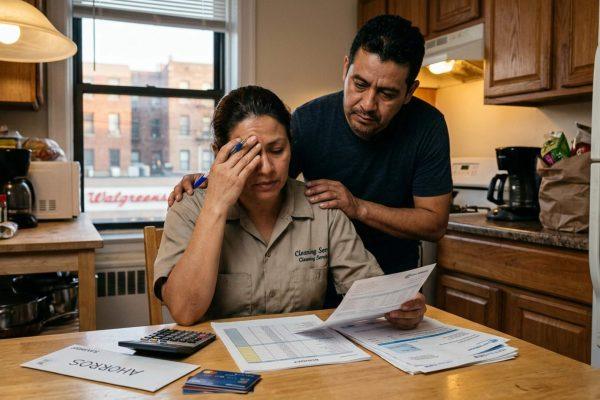
For many Latino households across the United States, the economic recovery touted by macroeconomic indicators feels like a distant rumor. While GDP figures show growth, the day-to-day reality for families in cities like Los Angeles, Houston, and Miami is a relentless battle against rising costs and stagnant wages. According to Department of Labor data, an average family now needs roughly $6,400 per month to maintain the standard of living that cost $5,100 in 2020—a gap of $1,300 that goes almost entirely to housing, food, and healthcare.
This squeeze is especially acute for the Latino community, which makes up a disproportionate share of workers in service, agriculture, and construction—sectors where wages have barely budged. The federal minimum wage has remained frozen at $7.25 per hour since 2009, the longest stretch without an adjustment in U.S. history. Adjusted for inflation, that wage is now worth only 70% of what it was fifteen years ago. While states like California and New York have set higher local minimums, at least 21 million people nationwide remain trapped under the federal floor.
Survival Strategies at the Limit
To cope, seven out of ten Latino households have turned to second jobs, overtime, or credit cards. A study from the University of California found that 25% of Hispanic workers sought additional employment in the last year alone. Others have postponed utility payments or relied on high-interest credit cards to bridge the gap. Economist Mónica García notes, “When essential expenses absorb the entire salary, the concept of ‘saving’ stops being an option and becomes a physical impossibility for millions of residents.”
The strain is visible in daily choices. An alarming 40% of Latino families admit to skipping meals to save money, according to recent surveys. Housing costs alone consume more than 30% of total income for most, and food prices have climbed above the national average. The lack of health insurance—Latinos remain the group with the least access to coverage—turns any medical emergency into a financial catastrophe. Childcare costs have forced many parents to quit jobs or reduce hours, further shrinking household income.
This economic pressure also affects how Latinos navigate their dual identity in the U.S. As many forge a dual identity, balancing cultural roots with the demands of American life, the financial strain adds another layer of complexity. The dream of upward mobility feels increasingly out of reach for families who came here seeking opportunity.
A Call for Structural Reform
Advocacy organizations like UnidosUS are pushing for urgent measures: an immediate update to the federal minimum wage, expansion of healthcare subsidies, and more affordable childcare options. Without these changes, the inequality gap will continue to widen, perpetuating a cycle of precariousness that affects the health and educational future of Latino children.
In the meantime, the community shows remarkable resilience. But as economist García warns, the personal and social cost of this crisis threatens to leave deep scars. For now, millions of Latino families are left to navigate a system that promises growth but delivers only struggle.