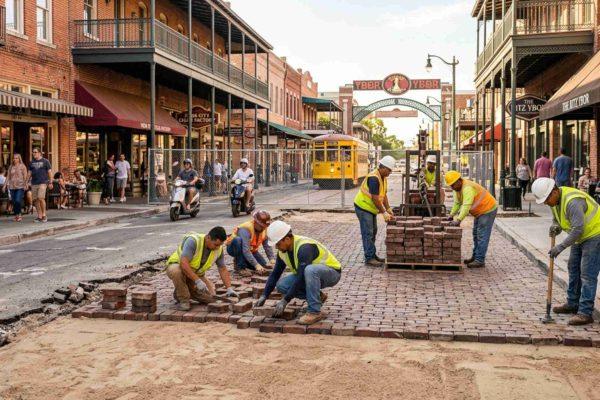
For a decade, residents and business owners in Ybor City have waited to see their beloved 7th Avenue reclaim its character. Now, the iconic strip is undergoing a transformation that brings back the original brick pavement—a move that promises to make the neighborhood safer for pedestrians while honoring its rich Latino history.
The restoration involves reinstalling 60,000 clay bricks, some of which are over a century old. Workers are laying each piece by hand, ensuring the surface is level for bicycles and vehicles alike. The goal is twofold: to restore the architectural charm that was buried under asphalt in the 1960s and to create a natural speed deterrent. The cobblestones produce a vibration that alerts drivers, encouraging them to slow down and be more mindful of people walking or riding scooters.
An Artisanal Tribute to Latino History
Ybor City was founded in 1886 by immigrants, many from Cuba, Spain, and Italy, who built a thriving tobacco industry. The bricks themselves are fragments of that collective memory. By salvaging original materials and matching them with locally sourced clay, the project ensures that the street’s aesthetic remains authentic. This is not just about safety—it’s about preserving a tangible link to the past.
The attention to detail is remarkable. Each brick is carefully leveled to avoid tripping hazards while maintaining the uneven texture that gives the street its vintage feel. This balance between durability and aesthetics is a nod to the neighborhood’s golden age, when 7th Avenue was the heart of Latino commerce and culture in Florida.
For many in the community, the return of the brick pavement is a victory against the uniformity of modern urban design. It reinforces the idea that Ybor City is not just another tourist destination but a living museum of Latino heritage. As one local business owner put it, “This street has soul. The bricks remind us of who we are and where we came from.”
Impact on Tourism and Urban Coexistence
Beyond the cultural significance, the restoration is expected to boost local commerce. By making the area more pedestrian-friendly, the city hopes to attract visitors seeking authentic experiences. Families can now stroll down 7th Avenue without worrying about speeding cars, and the improved safety encourages longer stays and more spending at the neighborhood’s restaurants, shops, and galleries.
Construction is being carried out with minimal disruption. All businesses and sidewalks remain open, and the project is scheduled to finish in record time. This careful planning reflects an understanding that Ybor City’s economy depends on its vibrant street life. The goal is to enhance the neighborhood without sacrificing its day-to-day energy.
Community leaders are optimistic. They see this investment as a way to ensure Ybor City remains relevant on Florida’s cultural map. In an era where many historic districts are losing their identity to chain stores and generic development, this project stands out as a commitment to authenticity. It’s a reminder that preserving the past can be a forward-looking strategy.
For bicultural Latinos, Ybor City has always been a symbol of resilience and creativity. The brick restoration is more than a safety upgrade—it’s a statement that the neighborhood’s heritage matters. As the city continues to evolve, projects like this help maintain the unique character that makes Ybor City a destination worth visiting.
While Florida often grabs headlines for its retirement communities and theme parks, stories like this show a different side of the state. For those interested in how other communities are rethinking urban spaces, check out our coverage of Brooklyn's Linden Boulevard safety overhaul and the vintage market revival in New York. And for a deeper look at Latino entrepreneurship, read about Antonela Roccuzzo's business empire.