California has cemented its role as the economic engine of the United States, reaching a nominal GDP of $4.25 trillion—a figure that not only dwarfs Texas, New York, and Florida but also underscores its dominance in cutting-edge industries. For Latino professionals and entrepreneurs across the Americas, this growth signals opportunity: Southern California is becoming the undisputed hub for aerospace and tech innovation, a shift that resonates deeply with communities from México to Chile who see the region as a gateway to global markets.
Contrary to the popular narrative of a mass exodus, recent data from the Los Angeles Times tells a different story. For every company that relocates out of state, nearly four new tech ventures emerge, creating a resilient and expanding business ecosystem. This is especially true in the southern part of the state, where cities like Long Beach and El Segundo have become magnets for next-generation aerospace firms.
The New Southern Aerospace Cluster
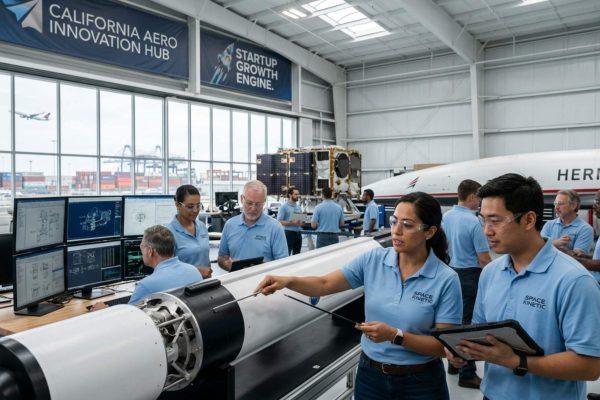
The tech boom is no longer confined to Silicon Valley. Southern California has emerged as the new frontier for space innovation, with companies like Hermeus, Vast, and Voyager Technologies setting up shop in Long Beach and El Segundo. These firms are drawn by specialized infrastructure and proximity to defense suppliers, proving that the region remains the preferred launchpad for startups with global ambitions. For Latin American engineers and scientists looking to break into aerospace, this cluster offers a direct path to the industry's cutting edge.
This internal migration southward is a testament to California's enduring appeal. The state's ability to attract and retain talent is unmatched, thanks in part to its impressive educational infrastructure. With over 600 higher education institutions—one for every 64,000 residents—California produces the highest number of engineers in the country. This talent pipeline feeds nearly 400 unicorn companies valued at over $1 billion, creating a virtuous cycle of innovation and investment.
California's allure for investors is undeniable. The state captures 62% of all venture capital funds in the United States, according to Bloomberg data, and accounts for more than 30% of all investment operations nationwide. This capital flow ensures that new ideas have the resources to scale quickly, from aerospace startups to biotech firms. For Latino entrepreneurs, this means access to funding that can turn a concept into a global enterprise.
Despite high operating costs, California has implemented public-private collaboration programs that help retain major tech players. The commitment to productive diversification and technological innovation has allowed sustained growth, impacting not only the regional economy but also projecting the Californian model toward international markets. As the 2026 World Cup approaches, with matches in Los Angeles and other U.S. cities, the region's infrastructure and innovation capacity will be on full display—a moment for Latino communities to celebrate their role in shaping this future.
For those considering a move to California, the financial realities are worth weighing. The state's high cost of living has driven some middle-class families to seek relief elsewhere, as explored in our piece Beyond Broke: The Financial Squeeze Fueling California's Middle-Class Exodus. Yet for many, the cultural and professional opportunities outweigh the costs. The cultural cost of leaving can be steep, especially for those who value the vibrant Latino communities that define cities like Los Angeles and San Diego.
Southern California's aerospace leadership is not just a story of economic might; it's a narrative of resilience and reinvention. As the region prepares for the 2026 World Cup, with Amtrak's Pacific Surfliner offering expanded service to connect fans across the state, the synergy between innovation and culture will be impossible to ignore. For Latinos in the diaspora, this is a moment to claim a stake in the future—one built on the same ingenuity and determination that have always defined our communities.