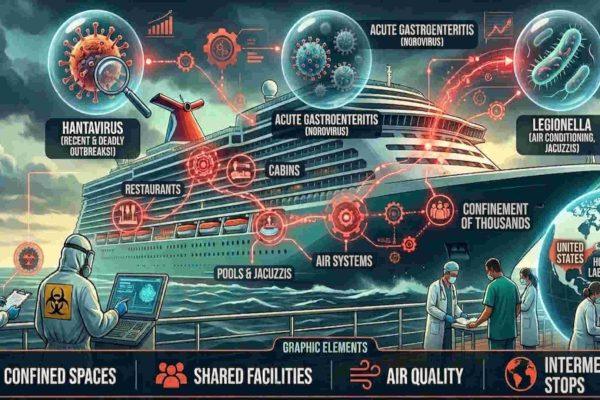
For many Latinos, a cruise is a dream vacation—a chance to explore the Caribbean, the Mexican Riviera, or the coasts of South America. But recent health emergencies are casting a shadow over that dream. In the past year, outbreaks of hantavirus and norovirus have forced ships to evacuate, quarantine, and even strand passengers in foreign ports. The reality is that these floating resorts, for all their glamour, can become breeding grounds for infectious diseases.
Health experts describe cruise ships as closed ecosystems where thousands of people share recycled air, common surfaces, and tight quarters for days on end. Dr. Ana Lucía Méndez, an infectious disease specialist based in Bogotá, explains: “In a cruise ship, you have a captive population breathing the same air, touching the same railings, and eating from the same buffets. That makes transmission far more efficient than in a hotel or even a hospital.”
The numbers back her up. In 2025 alone, the U.S. Centers for Disease Control and Prevention (CDC) recorded 23 norovirus outbreaks on ships docking in U.S. ports. Norovirus, often called “the cruise ship virus,” causes acute gastroenteritis—vomiting, diarrhea, and dehydration. Meanwhile, the hantavirus outbreak on the MV Hondius, which originated from a cruise departing Argentina, resulted in three deaths and nine confirmed infections. That incident triggered monitoring of passengers across five U.S. states, including New York, as reported in our earlier coverage.
Why Cruise Ships Are So Vulnerable
Several factors make cruise ships uniquely susceptible to outbreaks. First, the ventilation systems recirculate air throughout the vessel, meaning a single infected person can spread respiratory droplets to hundreds. Second, passengers and crew share dining areas, entertainment venues, and restrooms, creating countless touchpoints for gastrointestinal viruses. Third, intermediate stops at ports like Cozumel, Cartagena, or San Juan introduce new passengers and supplies, each potentially carrying pathogens.
“Every time a ship docks, it’s like opening a door for a new virus to walk in,” says Dr. Carlos Rivera, an epidemiologist at the University of Buenos Aires. “And once it’s inside, the confined space makes it almost impossible to contain.”
The Ambition, a cruise ship operated by a European line, became stranded in France after a gastroenteritis outbreak sickened dozens. Passengers were confined to their cabins while authorities conducted sanitation protocols. Such incidents are not isolated; they reflect a systemic vulnerability that the cruise industry has struggled to address.
Legal and Regulatory Challenges
For passengers who fall ill, seeking compensation is notoriously difficult. Cruise contracts typically include clauses that waive liability for illnesses or deaths, unless gross negligence can be proven. That legal hurdle has led to the dismissal of many lawsuits in U.S. courts. Even when outbreaks are traced to contaminated food or poor sanitation, proving negligence requires extensive documentation and expert testimony.
International protocols, such as those from the CDC and the World Health Organization, set guidelines for sanitation and outbreak response. But enforcement varies by port country. Ships that dock in the United States must comply with CDC’s Vessel Sanitation Program, which conducts unannounced inspections. However, ships operating primarily in Latin American waters may face less rigorous oversight.
For Latino travelers, the risks are particularly relevant. Many cruises depart from or visit ports in México, Argentina, Colombia, and other Latin American nations. The hantavirus outbreak on a cruise from Argentina underscores how quickly a local disease can become an international health crisis. Similarly, norovirus outbreaks on ships that stop in Puerto Rico or the Dominican Republic affect both local populations and tourists.
Despite these risks, the cruise industry continues to grow. New ships like Virgin Voyages’ Brilliant Lady are launching adults-only itineraries from Los Angeles, targeting a younger, health-conscious demographic. But as our report on that ship notes, even modern vessels are not immune to outbreaks.
For now, the best defense is awareness. Travelers should check a ship’s sanitation record, purchase travel insurance that covers medical evacuation, and practice good hygiene—frequent handwashing, avoiding shared utensils, and reporting symptoms immediately. As Dr. Méndez puts it: “The ocean is vast, but the ship is small. Don’t let a vacation become a vector.”