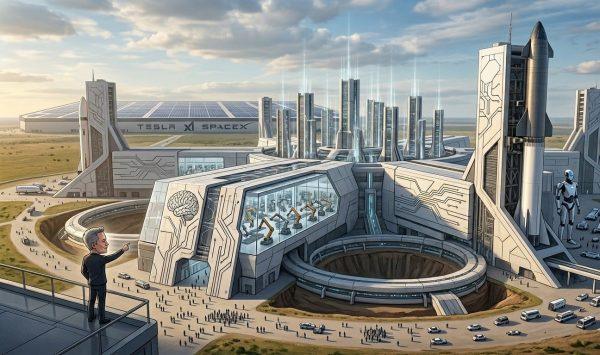
Elon Musk is doubling down on his vision for the future with Terafab, a massive chip manufacturing facility in Grimes County, Texas. With an initial investment of $55 billion and a total projected cost of $119 billion, this megafactory is designed to produce the advanced semiconductors that will drive his empire—from Tesla's self-driving cars and humanoid robots to SpaceX's Starlink satellites and the AI ambitions of xAI.
The move is a direct response to what Musk sees as an impending chip shortage, fueled by the exploding demand for large language models and autonomous driving technology. By bringing production in-house, Musk aims to bypass the global supply chain vulnerabilities that have plagued the tech industry, particularly the reliance on East Asian foundries like TSMC in Taiwan and Samsung in South Korea.
Vertical Integration for a Trillion-Dollar Empire
Terafab isn't just about building chips; it's about building a self-contained ecosystem. For Tesla, the factory will produce next-generation processors critical for Full Self-Driving (FSD) software and the Optimus humanoid robot. SpaceX needs resilient, high-efficiency chips for Starlink's expanding satellite network and deep-space navigation. And xAI, recently valued at $1.25 trillion, requires massive computing power to compete with Google and OpenAI.
By controlling the entire chip architecture—from design to manufacturing to assembly—Musk can optimize hardware specifically for his own AI algorithms, reducing costs and increasing performance. This vertical integration is a strategic play to ensure that his companies are not held back by external suppliers.
A Strategic Alliance with Intel
One of the most striking aspects of Terafab is the partnership with Intel. The chip giant will collaborate on design, manufacturing, and assembly of ultra-high-performance semiconductors. For Intel, this is a chance to regain relevance in the foundry business, which has been dominated by TSMC. For Musk, it provides decades of expertise in photolithography and advanced packaging.
Musk described the effort on his social platform X as “the most epic chip-building effort in history,” aiming to integrate logic, memory, and assembly under one roof. The collaboration could accelerate the timeline for producing prototypes, which typically takes three to five years for such facilities.
Geopolitical and Industrial Implications
Terafab also aligns with broader U.S. and European efforts to reduce dependence on Asian semiconductor manufacturing. SpaceX has already called the plant a “transformative investment” for the country's technological capacity. If successful, Musk will not only own the most advanced rockets and electric cars but also the electronic “brains” that power them, consolidating a vertical monopoly over the infrastructure of the future.
For Latinos in tech and business, this development underscores the importance of financial future faking—a trend where young Latinos are divorcing over money lies—but also highlights the need for strategic investments in innovation. As Musk pushes the boundaries of what's possible, his approach serves as a reminder that control over critical technologies is key to long-term success.
While the factory's impact on the global chip market remains to be seen, one thing is clear: Musk is betting big on a future where his companies are self-sufficient, and Terafab is the cornerstone of that vision.