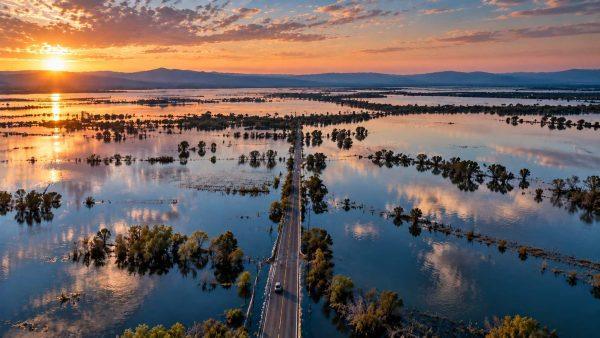
For over a century, Tulare Lake was a ghost on California's landscape—a name on old maps, a memory in the stories of the Tachi Yokut Tribe. Then, in 2023, a series of atmospheric rivers turned the San Joaquin Valley into a temporary inland sea, and the lake that had been drained and plowed under returned with a force that stunned locals and scientists alike.
A lake that refused to stay buried
At its peak, Tulare Lake stretched up to 100 miles long and 30 miles wide, covering an area larger than some states. But in the late 19th century, settlers diverted the rivers that fed it—the Kings, Kaweah, Tule, and Kern—for irrigation and agriculture. By 1890, the lake had essentially vanished, replaced by cotton fields and orchards. The land was so thoroughly transformed that few could imagine water ever stood there.
That changed dramatically in 2023. Record-breaking snowpack in the Sierra Nevada and relentless rain sent runoff pouring into the lake's ancient basin. Within weeks, water covered more than 100 square miles, swallowing farmland, roads, and even some structures. The return was not just a hydrological event—it was a cultural one. For the Tachi Yokut Tribe, who call the lake Pa'ashi, its reappearance carried deep spiritual significance, a reminder of a landscape they had never forgotten.
The lake's resurgence also brought life back to the region. Fish, amphibians, and migratory birds returned to the temporary wetlands, creating an impromptu wildlife refuge. Farmers, however, faced devastating losses as their fields disappeared underwater. The tension between agricultural needs and the lake's natural cycles is a story as old as California itself.
But the comeback was fleeting. By early 2024, Tulare Lake had shrunk from roughly 180 square miles to scattered pools, as water evaporated and was redirected for human use. NASA satellite imagery documented the lake's gradual disappearance, leaving behind cracked mud and a sense of déjà vu.
This is not the first time Tulare Lake has reappeared. It resurfaced during wet periods in the 1930s, 1960s, and 1980s, only to recede again. Scientists say that as climate change intensifies, extreme precipitation events may become more frequent, making the lake's returns less of an anomaly and more of a recurring pattern. In that sense, California's "lost lake" might better be described as a sleeping giant.
For the Tachi Yokut Tribe, the lake's return was a validation of their oral history, which had always spoken of the water's power. "Our people have known Pa'ashi for thousands of years," said tribal chairman Leo Sisco in an interview. "Its return is a reminder that the land remembers what was taken from it."
As California grapples with the challenges of a changing climate, the story of Tulare Lake offers a lesson in humility. The state's infrastructure was built on the assumption that the lake would stay dry, but nature has other plans. Whether the lake will return again—and what that means for the communities that now occupy its basin—remains an open question.
For now, the lake is mostly gone, but its legacy persists. The land, the water, and the people who remember are all part of a cycle that defies easy resolution. As the state prepares for future storms, the ghost of Tulare Lake stands as a reminder that in California, the past is never truly buried.