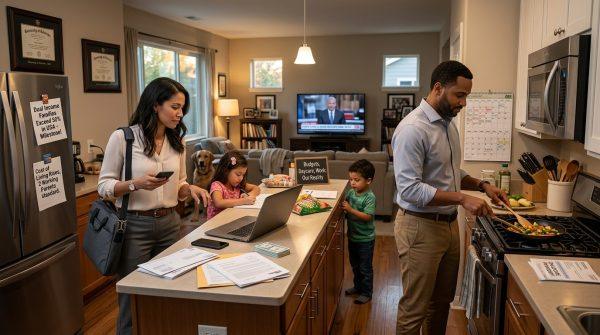
For decades, the image of the sole breadwinner—often a father heading off to work while a mother stays home—was central to the American dream. But that picture has shifted dramatically. According to a new analysis from the Pew Research Center, dual-income households now make up more than half of all families with children in the United States. This isn't a temporary trend; it's a structural change driven by rising housing costs, stagnant wages, and the escalating price of daily life.
For Latino families across the Americas and the diaspora, this reality hits especially hard. In cities like Houston, New York, and Los Angeles—where many Latino communities are concentrated—the cost of living has outpaced income growth for years. A single paycheck, even a solid one, often falls short of covering rent, groceries, healthcare, and childcare. As a result, both parents working is no longer a choice but a necessity.
The Budgetary Squeeze on Two-Income Households
Having two earners in a household brings obvious benefits: more cash flow, a buffer against inflation, and the ability to save for emergencies. But it also comes with hidden costs. Financial planners point out that when both partners earn income, families often move into higher marginal tax brackets, reducing the net gain from the second salary. Add in commuting expenses, professional clothing, and the convenience foods that busy parents rely on, and that second paycheck can shrink significantly.
Yet the long-term picture is more encouraging. Dual earners accumulate higher baseline eligibility for Social Security benefits and employer-matched retirement plans over their working lifetimes. For Latino families, who historically have lower rates of retirement savings, this can be a crucial wealth-building tool. As one economist put it, the immediate marginal costs of maintaining a two-income household are often outweighed by the generational gains in financial stability.
The Childcare Paradox
Childcare remains the single biggest expense for many working families. In major metro areas, daycare for two infants can cost as much as the salary of the lower-earning parent. That creates a painful paradox: working to pay for care, or staying home and losing health insurance and retirement contributions. For Latino families, who often rely on extended family networks for support, the formal daycare system can feel both expensive and culturally disconnected.
Some families are turning to creative solutions. In states like Texas and California, informal care-sharing arrangements among neighbors and relatives help reduce costs. Others are exploring tiny home options, like the Boxabl casitas that offer affordable living spaces for multigenerational households. Meanwhile, programs like the Child Care and Development Fund provide direct subsidies to moderate-income families, though demand far exceeds supply.
What This Means for the Latino Community
The shift to dual incomes is reshaping not just household budgets but also cultural expectations. In many Latino families, the idea of both parents working was once seen as a temporary measure or a sign of struggle. Today, it's increasingly viewed as a strategic choice for building long-term wealth and security. As one mother in Union City, New Jersey, told us, we're not just surviving—we're investing in our kids' future.
Still, the pressure is real. A recent report highlighted how young families are fleeing Union City as costs rise and amenities fail to keep pace. Similarly, in New York, top counties are slipping out of reach for working families. For Latino households, these trends underscore the importance of financial literacy, tax planning, and community support networks.
Ultimately, the two-income family is here to stay. And while it brings challenges, it also offers a path toward the kind of stability that the American dream once promised—but now requires two paychecks to achieve.