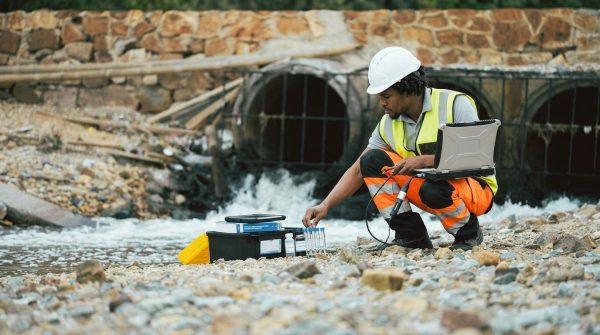
As artificial intelligence reshapes industries from Austin to the Permian Basin, its appetite for electricity and water is growing faster than the grid can handle. In Texas, where drought is a recurring reality, the clash between tech expansion and water scarcity has become impossible to ignore. But a team of engineers and geoscientists at the University of Texas at Austin believes the solution may already be flowing through the state's industrial pipes.
Their proposal: treat and reuse wastewater—from brackish aquifers, industrial runoff, even oilfield brine—to cool the powerful servers that run AI models. The idea is gaining traction as state regulators and local communities push back against the unchecked growth of data centers that guzzle millions of gallons of freshwater each day.
A new metric for water-smart tech
Researchers at the Cockrell School of Engineering and the Jackson School of Geosciences have developed a new tool called the Saline Water Utilization Intensity (SWUI) to measure how different desalination strategies affect local water stress. Their findings, published in the journal Water Research, show that high-recovery desalination systems can reduce regional water stress by up to 40% in vulnerable ecosystems, even when energy use rises slightly.
“We don’t need to wait for futuristic technology,” says Vaibhav Bahadur, a professor of mechanical engineering and one of the study’s authors. “Existing filtration systems can already turn saline water into a reliable cooling source for data centers. The challenge is operational cost, but the environmental payoff is real.”
The team tested reverse osmosis on brackish water with 5,000 parts per million (ppm) of dissolved salts, and on seawater with 35,000 ppm. They also ran hybrid systems using mechanical vapor compression on oilfield wastewater with salinity above 50,000 ppm. The results were promising: they recovered 736 liters of clean water per 1,000 kilograms of seawater at a cost of $3.20 per cubic meter. Treating oilfield water, however, required four times more energy and tripled operational costs—a trade-off that may still be worth it in water-stressed regions.
Texas data centers face a water reckoning
The urgency is real. A recent state analysis projects that data center water demand could quadruple by 2028, reaching between 150 billion and 270 billion liters annually. That’s enough to supply a city of over a million people. In September 2026, Governor Greg Abbott paused new data center permits while the state attorney general’s office launched audits into industrial water consumption.
For communities along the Texas-New Mexico border, the issue is already acute. AI data centers along the border threaten climate and water, and residents worry that their aquifers will be drained to cool servers in distant server farms. The new research offers a path forward that doesn’t pit tech against towns.
Oilfield wastewater: from liability to asset
One of the most intriguing angles is the reuse of oilfield wastewater. In the Permian Basin, oil producers discharge an enormous volume of industrial byproduct daily—enough to fill 1,200 Olympic swimming pools. Currently, most of that water is injected deep underground, a practice that Bahadur warns is not only wasteful but risky.
“Subsurface injection increases seismic hazards, and we’re running out of disposal capacity by 2030,” he says. “Reusing that water for cooling is a smarter, safer alternative.”
The economics are still challenging. Treating hypersaline fluids with vapor compression quadruples energy consumption, but that’s a fraction of what the data centers themselves consume. And in drought-prone counties, even minimal liquid discharge strategies can significantly boost freshwater recovery.
Policy and the road ahead
The research team has taken its findings to the Texas Senate Committee on Water, Agriculture and Rural Affairs. Ning Lin, chief economist at the Bureau of Economic Geology, and colleagues from the COMPASS consortium testified that local officials need objective environmental data when evaluating tech proposals. “We’re not saying every data center should run on wastewater,” Lin said. “But for those in arid regions, it’s a viable option that preserves municipal supplies.”
The approach is already being tested in Longview, in eastern Texas, where a two-stage reverse osmosis system treats underground brackish streams. That project has shown the lowest environmental impact scores, with moderate energy use and low operational costs—a model that could be replicated across the state.
For Latinos in Texas, many of whom live in communities disproportionately affected by water scarcity, this research offers a glimmer of hope. It’s a reminder that innovation can serve both the economy and the environment, and that the state’s water future doesn’t have to be a zero-sum game.
As the debate over data center growth continues, the message from Austin is clear: the solution to the water problem isn’t just about building bigger pipes—it’s about being smarter with the water we already have.