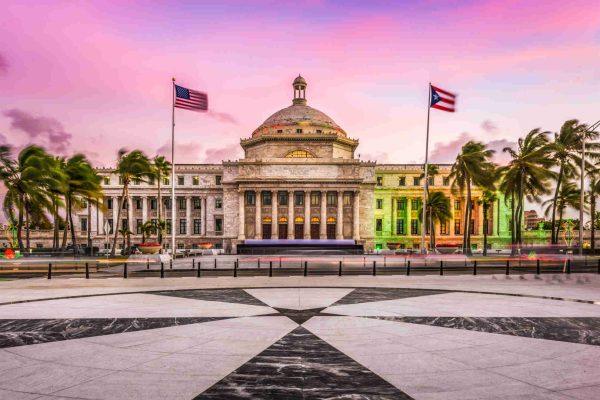
For 125 years, Puerto Rico has existed in a political gray zone—neither fully part of the United States nor independent. Since U.S. troops landed during the Spanish-American War in 1898, the island has been an unincorporated territory, a status that the Supreme Court cemented in 1901 with the infamous Insular Cases, declaring Puerto Rico a place that belongs to but is not part of the United States. This legal limbo continues to define the lives of 3.2 million Puerto Ricans, who carry American passports but cannot vote for president and have no voting representation in Congress.
The tension between belonging and exclusion is nothing new. In 1917, the Jones-Shafroth Act granted U.S. citizenship to Puerto Ricans, but it came with strings attached: islanders were subject to military service and federal laws, yet denied the full rights of citizens in the 50 states. Today, that asymmetry remains. Puerto Ricans pay some federal taxes, but not federal income tax on island-source income. They receive less funding for Medicaid, Medicare, and food assistance than any state. And when the island faced an unpayable $70 billion public debt crisis in 2016, Congress imposed a fiscal oversight board—known locally as La Junta—that stripped elected officials of budgetary control, a move many in San Juan and across the archipelago see as a colonial relic.
A Referendum That Goes Nowhere
Since 1967, Puerto Ricans have gone to the polls six times to vote on their political status. The most recent, in November 2020, asked a simple yes-or-no question: “Should Puerto Rico be admitted immediately as a state?” A majority—52.5%—said yes. But the vote was nonbinding, and nearly half of voters chose either “no” or left the ballot blank, reflecting deep divisions. Meanwhile, in Washington, the bill to authorize a binding statehood process has stalled in the Senate, where neither party has made it a priority. The result is a legislative labyrinth that frustrates even the most optimistic advocates of estadidad.
The lack of consensus isn’t just in Congress. On the island, the debate is generational and ideological. The pro-statehood New Progressive Party (PNP) has held the governor’s mansion for much of the last two decades, but the Popular Democratic Party (PPD), which favors the current territorial status with enhanced autonomy, and the Puerto Rican Independence Party (PIP) both argue that statehood would erase the island’s distinct culture and language. In the streets of San Juan, you’ll hear everything from calls for full independence to demands for a 51st star on the flag. This fragmentation makes it easy for Washington to kick the can down the road.
Meanwhile, the economic and social costs of limbo are real. Puerto Rico’s per capita income is roughly half that of Mississippi, the poorest U.S. state. The island has lost nearly 20% of its population since 2000, with many moving to Orlando, New York, and other mainland cities in search of jobs and better services. Those who stay face a crumbling infrastructure, frequent power outages, and a healthcare system that struggles to retain doctors. The cultural contributions of Puerto Ricans—from Bad Bunny’s global reggaeton to the literature of Giannina Braschi—are celebrated worldwide, but the island’s political status remains a stubborn obstacle to its prosperity.
For many, the issue is one of basic fairness. Puerto Ricans have fought and died in every U.S. war since World War I. They contribute to Social Security and Medicare. They are American in every way except the one that matters most: the right to shape the laws that govern them. As the 2024 election approaches, some Democratic and Republican lawmakers have reintroduced the Puerto Rico Status Act, which would allow for a binding plebiscite with three options: statehood, independence, or sovereignty in free association. But the bill faces an uphill battle in a divided Congress, where the politics of the Caribbean often take a backseat to mainland concerns.
The paradox is that Puerto Rico is already deeply integrated into the fabric of the United States. Its people are citizens. Its culture influences music, food, and fashion from the Bronx to Los Angeles. Yet legally, the island remains what the Supreme Court called in 1901 “foreign to the United States in a domestic sense.” Until that contradiction is resolved, the dream of becoming the 51st state—or any other status—will remain just that: a dream deferred.