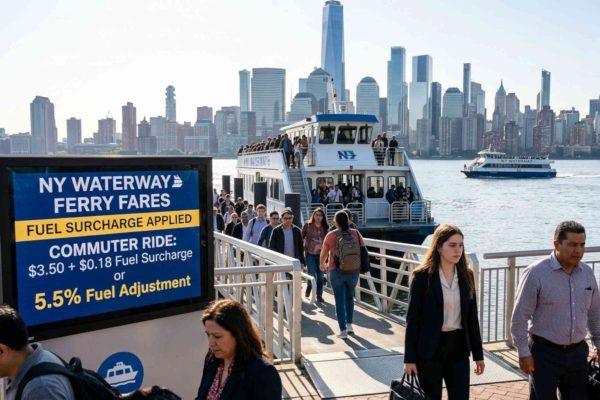
For thousands of commuters crossing the Hudson River each day, the cost of getting to work just went up. NY Waterway, the private ferry operator connecting Manhattan with New Jersey towns like Hoboken and Weehawken, has introduced a 5.5% temporary fuel surcharge on all tickets. The increase, effective this Monday, adds roughly 18 cents to the standard $3.50 one-way fare, pushing a daily round trip to about $7.40. For regular riders—many of them Latino workers and Gen Z professionals—that adds up to over $155 a month.
The company says the surcharge is a direct response to an 80% rise in fuel costs since January, with diesel prices recently topping $4.10 per gallon. In a letter to customers, CEO Armand Pohan explained that the spike has created unsustainable financial pressure on operations. While the surcharge is labeled temporary, NY Waterway has not set an end date, citing ongoing volatility in international energy markets.
Why This Matters for Latino Commuters
For many in the Latino community, the ferry is more than a convenience—it's a lifeline. Workers in construction, hospitality, and service industries often rely on the speed and reliability of the Hudson River crossings to avoid subway delays and overcrowding. The added expense, though modest per trip, chips away at already tight budgets. As gas prices remain high across the U.S., any increase in transportation costs hits hard.
Pat Smith, a spokesperson for NY Waterway, emphasized that the company explored every alternative before passing costs to passengers. “We understand the burden this places on our riders,” Smith said. “But with fuel costs rising so sharply, we had to act to maintain service frequency and reliability.” The Port Authority of New York and New Jersey, which oversees regional transit, has not intervened, leaving private operators to adjust fares as they see fit.
Local officials in New York are monitoring the situation, but no immediate relief is in sight. Transit authorities suggest alternatives like public bicycles or buses, though they acknowledge that ferry speed remains a key advantage for the regional workforce. For now, commuters must brace for continued volatility through the second half of the year.
The surcharge follows a broader trend in the U.S. transportation sector. The United States Postal Service, for instance, recently implemented temporary increases of up to 8% on certain package rates for similar fuel-related reasons. NY Waterway’s move is part of a pattern where rising energy costs ripple through daily life, affecting everything from small business operations to personal budgets.
For Latino families and young professionals who depend on the ferry, the message is clear: plan for higher costs. The company promises to notify customers as soon as the surcharge is lifted, but with global energy markets in flux, that date remains uncertain. In the meantime, riders are left to weigh the ferry’s speed against its growing price tag.