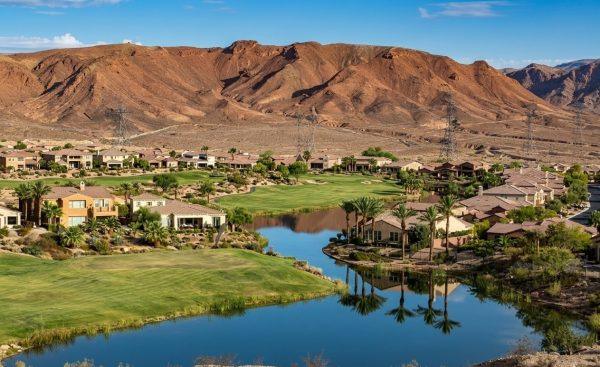
What was meant to be a peaceful retirement haven in Nevada has turned into a costly legal battle. Nearly 90 luxury homes in the exclusive Del Webb development at Lake Las Vegas are showing signs of sinking, with cracked walls, shifting foundations, and backyards literally giving way. The homeowners association has filed a lawsuit against Pulte Homes, accusing the builder of constructing on unstable soils that were never suitable for such dense development.
The lawsuit, filed in Nevada courts, details how these dream homes—many purchased by retirees seeking a quiet life near Henderson—are now plagued by structural failures. Attorney William Coulthard, representing the affected homeowners, explained that the community was built on an alluvial fan, a natural sediment deposit. To level the steep terrain, Pulte used fill up to 15 meters deep. Experts hired by the association point to “hydro-collapsible soils,” which weaken and compact when wet, as the likely culprit. “These were the dream retirement homes that have turned into a structural nightmare,” Coulthard said.
A Geological Gamble in the Desert
Lake Las Vegas, a planned community spanning over 1,400 hectares, has long been a coveted residential destination. After financial struggles in the 2010s, it rebounded as a luxury enclave. But this scandal raises questions about future expansions in a state where the ground itself seems unpredictable. The soil issue is not unique to Nevada—similar challenges have affected developments in California and Arizona, where rapid growth meets complex geology. For Latino families and workers in the region, who often bear the brunt of housing instability, this case underscores the risks of unchecked development. As Nevada attracts more Californians seeking affordable housing, ensuring soil stability becomes critical.
PulteGroup, the builder, rejects the allegations of widespread negligence. In a statement, spokesperson Ally Boyle said the company stands by its construction quality, noting that reported problems affect less than 5% of the community. They claim repairs have started or completed on 43 properties, and an independent expert found retaining walls functional. Boyle criticized the legal route, suggesting it delays technical fixes: “It is disappointing that the association has opted for a path that delays technical corrections.”
The legal standoff now hinges on procedure. Pulte wants the case moved to private arbitration, which would keep details out of public court records. The homeowners demand a jury trial in open Nevada court, arguing transparency is essential. This dispute mirrors broader tensions in the housing market, where economic pressures squeeze families and developers face scrutiny over long-term quality.
For the Latino community in Nevada, many of whom work in construction or service industries tied to real estate, this story hits close to home. The state's rapid growth has brought jobs but also risks, as seen in other communities grappling with environmental hazards. While Lake Las Vegas is an affluent area, the fallout from such failures can ripple through local economies, affecting workers and small businesses.
As the case unfolds, it serves as a cautionary tale about the intersection of luxury development and geological reality. The ground beneath Nevada may be shifting, but the legal battle over who pays for the damage is just beginning.