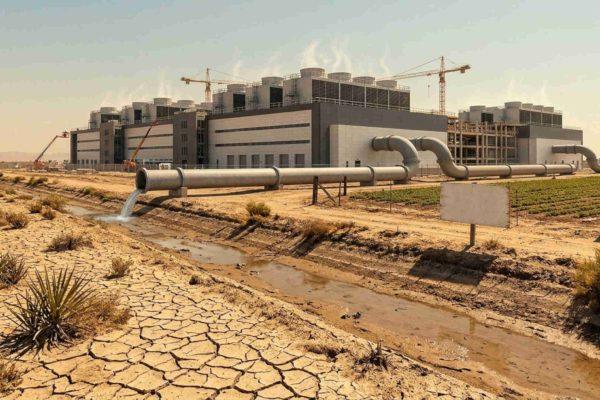
In the heart of Southern California's Imperial Valley, a proposed high-tech hub is stirring deep unease among the region's predominantly Latino population. The project, a state-of-the-art data center requiring 330 megawatts of energy and covering an area larger than 17 soccer fields, is seeking approval amid one of the most severe droughts in the Southwest's history. For the families and farmworkers who call this arid landscape home, the promise of technological progress feels like a threat to their most basic resource: water.
The data center, backed by a $10 billion investment, would consume an estimated 2.84 million liters of water daily by 2028. That's enough to supply roughly 10,000 people each day. On a national scale, data centers across the United States could demand up to 5.49 billion liters per day by 2030—a volume comparable to the daily water use of New York City. For the Imperial Valley, already grappling with the shrinking Colorado River, this new demand could push local supplies to the breaking point.
Local Concerns and Environmental Standards
Residents whose homes border the proposed site are voicing fears that the project will lead to residential water restrictions and a drop in property values. Many worry about noise, dust, and the potential loss of family gardens as utility rates climb. The City of Imperial is currently locked in a legal battle, demanding that the project meet stricter environmental standards under California's rigorous quality laws. For the Latino community and the agricultural workers who form the backbone of the local economy, this shift toward tech infrastructure represents a critical test of how resources are protected and allocated.
“We’ve seen what happens when big projects come in without real oversight,” said a local resident during a public hearing. “Our water is already tight. We can’t afford to lose more.” The tension highlights a growing conflict between the expansion of artificial intelligence and the essential need for water security in the region.
Infrastructure Costs and National Trends
On a larger scale, a single data center can demand up to 3.8 million liters of water daily for cooling during peak heat periods. Research from the University of California, Riverside, indicates that these facilities place intense episodic pressure on small community water systems. In California, adapting the water network to accommodate these tech hubs could require investments of up to $800 million. Yet, the lack of a centralized permitting authority and the failure of legislative attempts to mandate consumption reports leave many communities in the United States uncertain about the long-term sustainability of their water supplies.
This debate is not isolated to the Imperial Valley. Across the Southwest, the push for digital infrastructure is colliding with the realities of a changing climate. For Latino families who have farmed this land for generations, the stakes are personal. The Colorado River, which sustains millions, is already over-allocated. Adding a water-intensive data center to the equation could exacerbate existing inequalities.
As California continues to grapple with housing affordability and economic pressures—topics explored in our coverage of California's 'Rent Now, Pay Later' Model—the water crisis adds another layer of complexity. The state's small businesses, already battling rising costs as detailed in California Small Businesses Battle Rising Costs and Tariffs, now face the prospect of higher utility bills to support tech expansion.
The developer insists that service costs for residents will not increase, but skepticism runs deep. For the Latino community in the Imperial Valley, this is not just about data—it's about survival. The outcome of this legal dispute could set a precedent for how California balances technological ambition with the needs of its most vulnerable populations.