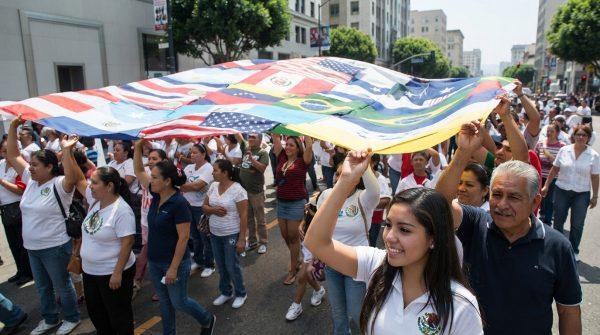
For millions of workers across the United States, the amount they earn per hour increasingly depends on which side of a city line they happen to clock in. Municipalities and states are pushing minimum wages far above the frozen federal rate of $7.25, which has not budged since July 2009. The result is a widening wage gap that hits Latino communities hard, especially those concentrated in service, hospitality, and construction jobs.
While Congress debates national proposals, local governments are taking matters into their own hands. From Seattle to Miami, officials are indexing pay to inflation, responding to the rising cost of living, and acknowledging that a one-size-fits-all federal standard no longer reflects urban realities. For Latino workers, many of whom are breadwinners supporting families, these local adjustments can mean the difference between making ends meet and falling behind.
Seattle leads the way
Seattle has long been a pioneer in municipal wage policy. Starting January 1, 2027, the city's minimum wage will climb to $22.14 per hour, a significant boost that adds roughly $840 million in regional purchasing power. The increase stems from a 2015 ordinance that requires annual reviews and advance notice each autumn. Seattle has also eliminated the old tiered system that distinguished by business size, and it now prohibits small businesses from counting tips or health plan contributions toward the minimum. For Latino workers in the city's bustling restaurant and retail sectors, this means a more predictable paycheck.
Washington state is following suit with a statewide rate of $17.73 per hour, a 3.5% increase over current levels. The adjustment is tied to August inflation data using the CPI-W index. The state is also raising salary thresholds for exempt employees, requiring companies with 51 or more workers to pay at least $1,773 per week. Smaller businesses face adjusted parameters. These changes are particularly relevant for Latino professionals in administrative roles who may have been misclassified as exempt.
Maine and Montana: different paths, same goal
Maine is set to raise its minimum wage to $15.70 per hour in 2027, thanks to an automatic indexation system under Title 26, Section 664. The law includes a federal parity clause, meaning if Congress ever raises the national floor above Maine's rate, the state will automatically align. This approach avoids annual legislative battles and ensures steady progress. For Latino workers in Maine's growing food processing and healthcare industries, the increase offers some relief from rising rents and grocery bills.
Montana takes a more conservative route, adjusting its rate to $11.20 per hour for the next cycle. The calculation relies on the Consumer Price Index for All Urban Consumers, with exceptions for businesses with limited annual sales. While the increase is modest, it still outpaces the federal floor. Latino workers in Montana, many employed in agriculture and meatpacking, will see a small but welcome bump.
Beyond state lines: local variations
The wage gap is not just between states—it's also within them. In Washington state, cities like SeaTac, Tukwila, and Renton have set rates above the statewide minimum, reflecting their higher costs of living. The District of Columbia leads the nation at $18.40 per hour, and more than 30 states now exceed the federal minimum. This patchwork creates a complex landscape for employers, who must navigate varying rules depending on their exact location. For Latino workers, it also means that moving just a few miles can change their earning power.
Federal legislation remains stalled, but senators have proposed bills to establish a national minimum with automatic indexation. Until then, local action is the primary driver of wage growth. As Florida's experience shows, even a $15 minimum can feel insufficient in high-cost areas. The debate over a unified national floor is far from over.
Economic impact and what it means for Latino families
These wage hikes have ripple effects. Small businesses must redesign budgets to absorb higher labor costs, but economists note that increased wages boost internal consumption, giving families more liquidity. For Latino-owned businesses, which often operate on thin margins, the challenge is real. Yet, compliance is non-negotiable, and penalties for underpayment can be severe. Workers, meanwhile, gain greater financial stability, which can translate into better housing, education, and health outcomes.
Looking ahead, labor unions and market analysts expect more municipalities to adopt automatic indexation formulas to protect purchasing power. Social pressure on lawmakers is likely to intensify, especially as the cost of living continues to rise. Corporations are also rethinking retention strategies, offering benefits beyond wages to attract talent in a competitive market. The trend toward decentralized wage policy seems set to expand, anchoring local economies to their own minimum wage dynamics.
For Latino workers, these changes are not just numbers on a paycheck—they are a lifeline. As the gap between federal and local rates widens, the push for a fairer, more responsive wage system grows stronger. Whether through city ordinances or state formulas, the message is clear: the federal floor is no longer enough.