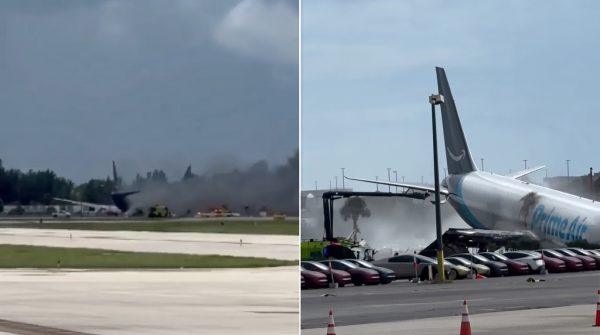
On Sunday, a cargo plane operating for Amazon Air crashed at Miami International Airport, veering off the runway and slamming into vehicles on an adjacent roadway. The impact killed at least five people and injured five others, triggering a massive emergency response and a federal investigation.
The aircraft, operated by 21 Air, was arriving at the airport when it failed to stop within the designated runway area. Witness video shared on social media shows the plane skidding across the tarmac and onto the road, where it struck several cars before coming to rest in flames. Emergency crews worked for hours to extinguish the fire and rescue those trapped in the wreckage.
What investigators are looking at
The National Transportation Safety Board (NTSB) and the Federal Aviation Administration (FAA) have launched a formal inquiry into the crash. Early attention is focused on whether the flight crew touched down within the proper landing zone, the role of wind gusts, and the condition of the runway and its surrounding infrastructure. Investigators are also reviewing the aircraft's maintenance history and the pilots' actions during the final approach.
"We are gathering all available data, including flight recorders, radar tracks, and video footage, to piece together the sequence of events," said an NTSB spokesperson. "Our goal is to determine what went wrong and to prevent a similar tragedy."
The airline has said it is fully cooperating with authorities, providing records and access to its operations. Preliminary reports indicate that data collection will continue over the coming weeks before any conclusions are released.
Aviation safety experts note that runway overruns are among the most dangerous types of accidents, especially at busy airports like Miami International, which handles a high volume of cargo and passenger traffic. "The margin for error is thin," said a former FAA safety inspector. "A combination of factors—weather, runway surface, braking action, and pilot technique—can all contribute."
The crash has also raised questions about the adequacy of safety buffers at airports. Some analysts point to the lack of additional containment systems, such as engineered materials arresting systems (EMAS), which are designed to stop aircraft that overshoot the runway. Miami International has EMAS at some runway ends, but not all.
Impact on travel and the community
The crash forced the temporary closure of several runways, leading to the cancellation of more than 180 flights and widespread delays. The Transportation Secretary urged travelers to plan for rescheduling and to consider alternate airports in the region. Operations partially resumed later in the day, but the disruption rippled through the busy cargo hub, which is a key gateway for Latin American trade.
Local authorities are coordinating assistance for the families of the deceased and the injured. Representatives of the companies involved expressed deep sorrow and pledged full cooperation with the investigation. "Our hearts go out to the victims and their loved ones," said a spokesperson for Amazon Air. "We are committed to supporting the investigation and to ensuring the highest safety standards."
The tragedy has resonated beyond Miami, especially in Latin American communities where the airport is a vital link to home countries. Many travelers and cargo workers have family ties across the region, and the crash has prompted conversations about aviation safety in the hemisphere.
This incident adds to a recent history of cargo aviation mishaps in the United States, which have drawn increased regulatory scrutiny. In the past few years, several cargo carriers have faced investigations for runway overruns and other safety lapses. The NTSB has repeatedly recommended improvements to runway safety areas and better training for pilots on rejected landings.
As the investigation unfolds, the focus remains on finding answers for the victims and their families. "We owe it to them to get this right," said the NTSB spokesperson. "Every detail matters."
For now, the Miami community mourns the loss of life and hopes that the lessons learned will lead to safer skies. The airport, a symbol of connection for the Americas, will carry the memory of this tragedy as it moves forward.