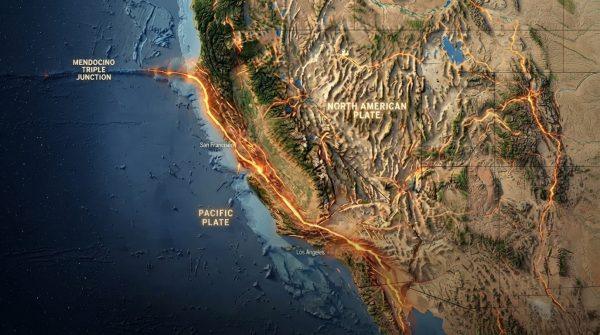
The San Andreas Fault is more than a California landmark—it's a dynamic boundary where the Pacific and North American plates grind past each other. For decades, scientists have known that powerful earthquakes can send ripples across the globe, but new research shows these distant tremors can actually influence the fault's behavior, sometimes triggering deep, subtle movements that are invisible at the surface.
This phenomenon, known as remote seismic triggering, occurs when seismic waves from a major earthquake travel thousands of miles and alter the underground stress in vulnerable fault zones. The San Andreas, already under immense pressure, can respond to these external pulses with micro-shocks or slow slips along its segments. It's a reminder that the Earth's crust operates as a connected system, not isolated compartments.
What scientists are seeing along the fault
Researchers from the U.S. Geological Survey (USGS) have documented increased deep tremor activity in the Parkfield-Cholame transition zone in central California following major global earthquakes. These tremors are not the dramatic surface ruptures we associate with big quakes, but they offer a window into how the fault reacts to distant energy. The effect is most pronounced in areas with high geothermal activity or where tectonic strain has been building for centuries.
“The San Andreas is like a coiled spring,” explains Dr. Elena Martínez, a seismologist at the University of California, Berkeley. “When a distant earthquake sends waves through the crust, it can give that spring a little nudge, sometimes enough to cause a small release, but not always enough to trigger a full rupture.”
This research is particularly relevant for Latin America, where recent seismic events have underscored the region's vulnerability. In June, a pair of powerful earthquakes—magnitudes 7.2 and 7.5—struck northern Venezuela, leaving more than 6,300 dead and causing widespread destruction. In August, a magnitude 7.4 quake hit Colombia's Chocó department near San José del Palmar, killing at least 181 people. And in July, a magnitude 7.3 temblor shook Chiapas, México, about 58 kilometers southwest of Puerto Madero, with tremors felt as far away as Panama.
These events are stark reminders of the tectonic forces that shape the Americas. They also feed into the broader conversation about how stress transfers across fault lines. The Colombia quake in particular has reignited focus on the region's seismic history and the potential for cascading effects.
The mechanics of remote triggering
Seismic waves from distant earthquakes can travel through the Earth's crust and mantle, causing dynamic stress changes in fault zones far from the epicenter. These changes are often small—millimeters of displacement—but they can be enough to push a fault that is already near its breaking point. The USGS uses a network of borehole sensors and satellite radar to detect these subtle movements, providing a real-time picture of how the fault responds to global seismic activity.
One of the most concerning aspects is the southern section of the San Andreas, which has been locked for more than 160 years. This segment, which runs near the Salton Sea and the densely populated Los Angeles metropolitan area, has accumulated enormous strain. Scientists warn that a major rupture here could be catastrophic, and remote triggering could potentially act as a catalyst.
“We're not saying that a distant earthquake will cause the 'Big One,'” says Dr. Carlos Herrera, a geophysicist at the Hawai'i Institute of Geophysics and Planetology. “But we are seeing that these events can increase the stress on already vulnerable faults, and that's something we need to monitor closely.”
The implications extend beyond California. In Latin America, the Pacific Ring of Fire runs along the western edge of the continent, making countries like Chile, Perú, and México particularly prone to large earthquakes. The same seismic waves that affect the San Andreas can also influence faults in these regions, creating a complex web of interconnected risk.
For now, the focus remains on surveillance and preparedness. The USGS continues to expand its monitoring network, and researchers are developing models that incorporate remote triggering into hazard assessments. As Dr. Martínez puts it, “We can't predict earthquakes, but we can understand the forces that drive them. That knowledge helps us build safer communities.”
For Latino communities on both sides of the border, this research is more than academic—it's a call to stay informed and prepared. Whether in Los Angeles or Bogotá, the ground beneath our feet is never as still as it seems.