The earth shook again in Colombia, and with it came a familiar wave of anxiety across the region. The recent tremor, centered in Chocó, has not only triggered aftershock warnings but also reopened conversations about the most powerful earthquakes ever recorded—and how many of them have struck Latin America.
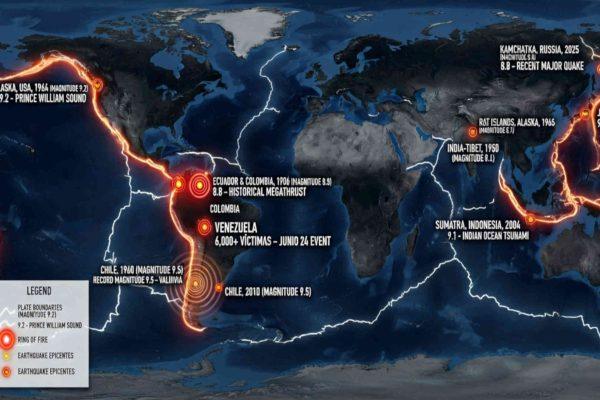
At the top of that list sits Chile's 1960 Valdivia earthquake, a colossal magnitude 9.5 event that remains the strongest ever measured by instruments. That quake, which unleashed a tsunami that reached as far as Hawaii and Japan, reshaped the coastline and left an indelible mark on the country's memory. It's a stark reminder that the Pacific Ring of Fire runs straight through our backyard.
Latin America's seismic heavyweights
Latin America's presence in the global earthquake ranking is no coincidence. The region sits atop several active tectonic plate boundaries, making it a hotspot for massive seismic activity. Beyond Chile's record, the 2010 Maule earthquake (magnitude 8.8) caused widespread damage and a tsunami that affected coastal communities. Earlier, in 1906, a magnitude 8.8 quake off the coasts of Ecuador and Colombia left a lasting impact on both countries.
These events are not just historical footnotes; they shape how we understand risk and preparedness. For many in the Latino community, especially those living in quake-prone areas, knowing the difference between magnitude and destruction is crucial. A quake's power doesn't always translate to casualties—it's the combination of building codes, population density, and tsunami readiness that determines the human toll.
Recent quakes that shook the world
The list of the world's largest earthquakes has been updated in recent years. In 2025, a magnitude 8.8 quake struck off Russia's Kamchatka Peninsula, generating tsunami warnings across the Pacific. That event joined the ranks of the top ten ever recorded. Japan's 2011 Tōhoku earthquake (magnitude 9.1) triggered a devastating tsunami and the Fukushima nuclear disaster, while Chile's 2010 Maule quake (magnitude 8.8) served as a stark reminder of the region's vulnerability.
For those following the science, these events highlight the importance of continuous monitoring. Modern systems like moment magnitude allow scientists to measure fault ruptures with precision, but the real challenge is translating that data into timely warnings. As Colombia's recent quake shows, even with advanced technology, the earth can still surprise us.
The human cost of earthquakes
While magnitude grabs headlines, it's the human toll that lingers. The double earthquake in Venezuela in June 2026, which struck on June 24, has surpassed 6,000 deaths according to official figures, making it one of the most devastating events in recent memory. The tragedy has sparked a solidarity movement across the diaspora, with communities in New York and beyond organizing relief efforts.
In Colombia, the recent quake has also disrupted daily life, leading to the postponement of major sporting events. CONMEBOL's decision to delay Copa Libertadores and Sudamericana matches underscores the quake's impact beyond the immediate destruction.
As we reflect on these seismic giants, it's worth remembering that our region's history is written not just in books but in the very ground beneath our feet. Each tremor is a reminder of our fragility, but also of our resilience. For Latin America, where the earth's fury is a constant companion, preparedness is not just a scientific exercise—it's a way of life.