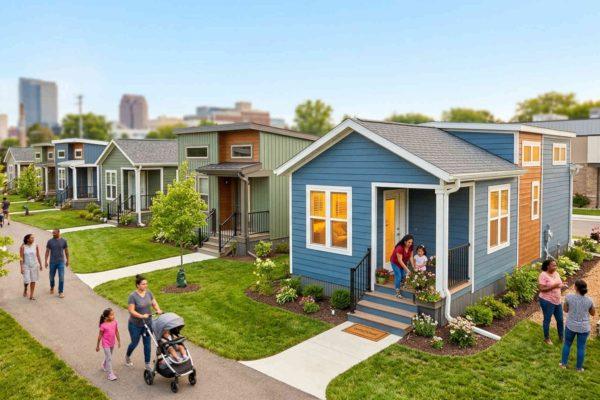
In Grand Rapids, Michigan, a new neighborhood of tiny homes is offering a fresh approach to the housing crisis, one that prioritizes dignity and long-term stability. Hope Village, a $3.5 million project developed by Mel Trotter Ministries and Next Step of West Michigan, opened its doors this year with 10 fully furnished units, and six more are set to be ready by the end of October. For the Latino community, which has seen a record 10.2 million homeowners in 2025, this model represents a tangible step toward closing the wealth gap and making the American dream of homeownership more accessible.
Each home, ranging from 400 to 530 square feet, is designed as a launchpad for people transitioning out of homelessness. The one- and two-bedroom dwellings come with in-unit laundry, an equipped kitchen, and full bathrooms—features that might seem basic but are transformative for those who have lacked stable housing. The rent is set at 30% of the tenant's income, and a portion of that payment is automatically deposited into a personal savings account, which can later be used for a down payment on a permanent home. This built-in savings mechanism is a key innovation, turning a monthly expense into an investment in the future.
A Model That Builds Community and Savings
The financial structure of Hope Village is unique. By capping rent at 30% of income, the program ensures that residents are not overburdened, while the automatic savings component helps them build a financial foundation. This is particularly relevant for Latino families, who often face barriers to traditional homeownership, such as lack of generational wealth or credit history. As Latinos hit a record 10.2 million homeowners in 2025, projects like Hope Village show how targeted initiatives can accelerate this trend.
Beyond housing, the village offers direct access to medical and mental health services at adjacent facilities, ensuring comprehensive support during the transition to independent living. The project intentionally mixes residents with different income levels: six homes are designated for low-income families, while four are rented at market rates. This creates a balanced community, avoiding the isolation that often plagues subsidized housing developments.
Built by the Community, for the Community
Construction began in March 2025, funded by private donations and state funds. The use of prefabricated structures sped up the process, and local authorities highlight that people who participated in workforce development programs helped build the homes. This creates a cycle of improvement: residents gain skills and employment, while the community benefits from new, affordable housing. The project sits on 1.65 acres in southeast Grand Rapids, and its success is already sparking interest from other cities facing similar housing deficits.
For the Latino diaspora, which often sends remittances back to home countries and struggles with high rents in US cities, this model offers a blueprint. In places like New York, where Latino tenants are bracing for a 2026 rent crisis, the idea of rent tied to income with a savings component could be a game-changer. Hope Village proves that affordable housing doesn't have to be a dead end; it can be a stepping stone to ownership and economic mobility.
As the US Latino economy hits $4.4 trillion, becoming the fourth largest in the world, the need for innovative housing solutions is more urgent than ever. Hope Village is a small but powerful example of how empathy and long-term vision can address the housing deficit, one tiny home at a time.