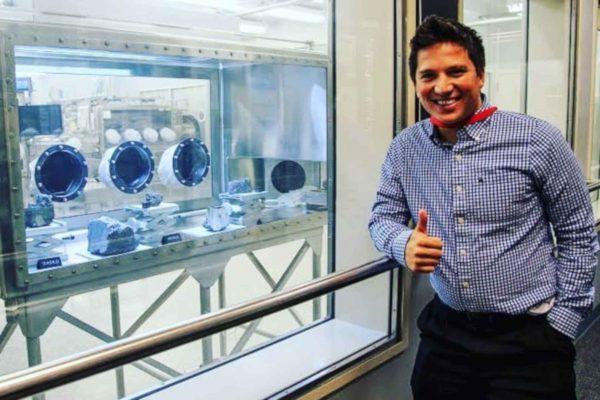
Manuel Retana Parra doesn't fit the stereotype of a NASA engineer who had it easy. The 30-year-old from San Miguel de Allende, Guanajuato, grew up speaking no English and faced 11 rejections from the space agency before finally securing an internship on his twelfth attempt at age 20. Today, he leads the team responsible for the emergency life-support systems on the historic Artemis II mission.
Retana's journey began in a classroom in San Miguel de Allende, where a physics teacher showed a rocket launch that sparked a lifelong dream. Though he was born in the United States to parents from Durango who worked in the fields, he grew up in Mexico and didn't speak a word of English as a child. At 15, he returned to the U.S. with a clear mission: learn the language, support his family, and reach the stars. Through sheer determination, he secured over ten scholarships to study mechanical engineering at the University of Nevada, Reno, followed by a master's degree from Stanford University.
Persistence Pays Off: 11 Rejections Later
For the Latino community, Retana's story is a masterclass in resilience. He faced 11 rejections from NASA before landing an internship at the Johnson Space Center on his twelfth try. He started his career testing pyrotechnics and explosives for spacecraft separation before moving into robotics and space operations. In 2020, he transitioned into life support systems, a role he describes as managing the spacecraft's air conditioning. This eventually placed him at the helm of the Artemis II emergency hardware team.
As a project manager, Retana led a team of 15 engineers in developing the Contingency Breathing System (CBS) for NASA's Orion spacecraft. His team took responsibility for 46 pieces of emergency equipment that flew with astronauts Reid Wiseman, Victor Glover, Christina Koch, and Jeremy Hansen. The system includes five breathing masks designed to provide clean air for eight hours during a fire emergency, each costing approximately $20,000. There's also the Orion Smoke Ejection Filter (OSEF), a high-tech filter valued at $250,000 that clears smoke and ash from the cabin within four hours. Additionally, the team developed 16 fire cartridges and 24 pre-filters to ensure the atmosphere remains breathable.
Mexican Ingenuity in Deep Space
Retana attributes much of his success to what he calls Mexican ingenuity—the ability to find simple and effective solutions to complex problems. He remains deeply connected to his roots, having founded the Mariachi Celestial within NASA to celebrate his heritage. While the crew of Artemis II successfully splashed down on April 10, 2026, after flying further than any humans in history, Retana's focus now shifts toward Artemis III and inspiring the next generation. He dreams of becoming a teacher to support young Latinos interested in space, demonstrating that no matter how far one travels, keeping one's feet firmly planted on the ground is what truly matters.
Retana's story resonates beyond the engineering world. It echoes the journeys of other Latinos who have broken barriers in their fields, like Bad Bunny and Romeo Santos, who recently made The New York Times' list of best living songwriters, or the greatest Latino first basemen who redefined MLB history. These stories remind us that persistence and cultural pride can take you from a classroom in San Miguel de Allende to the stars.