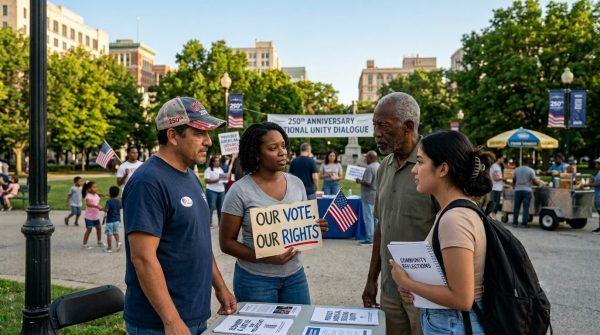
As the United States approaches its 250th anniversary, a new poll from Navigator Research offers a nuanced portrait of how Latino and Black communities view their place in the nation. The survey, conducted in June 2026, finds that pride in being American remains a deeply held value for over 80% of respondents from these communities. But that pride coexists with sharp concerns about economic survival, eroding rights, and political exclusion.
For many Latinos—whether in el barrio of East Los Angeles, the bustling streets of Houston, or the tight-knit neighborhoods of Chicago—national identity is not abstract. It is tied to family, to the sacrifices of previous generations, and to a belief in the country’s ideals. The poll confirms that belonging to the United States is seen as fundamental to grounding personal and family life, a sense of rootedness that goes beyond birthplace.
Economic Reality vs. The American Dream
Yet the data reveals a stark disconnect between patriotic sentiment and lived experience. Only one in five respondents believes the American dream is still within reach. Inflation and the rising cost of living have made homeownership a distant goal for many, and financial instability hits households hard. Barely 20% of families see economic well-being as viable, despite working long hours and often holding multiple jobs.
This economic pressure is especially acute for Latino communities, where remittances to families in México, Guatemala, or El Salvador add another layer of financial strain. The dream of upward mobility—once a cornerstone of the national narrative—now feels like a mirage for many, particularly younger generations who face a more expensive and uncertain landscape than their parents did.
Rights Under Threat
Beyond economics, the poll highlights deep unease about the state of civil liberties. Over 80% of respondents prioritize freedom of expression and voting rights, yet many feel these guarantees are weakening. The survey points to systemic barriers that disproportionately affect minorities, from unequal access to justice to polarizing political rhetoric that fosters a sense of exclusion.
This distrust is not new, but it is intensifying. As political discourse grows more divisive, many Latinos feel caught between a desire to fully participate in public life and a reality where their rights feel conditional. The erosion of individual guarantees, the poll suggests, complicates full integration into the country’s political and social fabric.
Resilience and Hope for the Future
Despite these challenges, the survey also reveals a resilient optimism. Nearly half of respondents remain confident that society can drive positive change. This hope is particularly strong among younger Latinos, who demand a firm democratic commitment that guarantees equity and respect for fundamental civil rights.
Diversity, the poll notes, is seen as an ineluctable strength of the nation. The future of the United States, many believe, depends on genuine inclusion and the protection of individual liberties. As one respondent put it, being proud to be American means ensuring that the country lives up to its founding ideals for everyone—not just a privileged few.
For Latino communities, this moment is both a reckoning and an opportunity. The 250th anniversary is not just a celebration of history; it is a chance to redefine what patriotism looks like in a multicultural, multiracial democracy. The poll makes clear that Latinos are not abandoning their pride in the United States. They are demanding that the nation earn it.
As the country grapples with economic instability and threats to civil rights, the resilience of Latino and Black communities offers a powerful counterpoint. The study underscores that guaranteeing equality for all population sectors is absolutely necessary to remain proud to be American. That, ultimately, is the democratic ideal that inspired the nation’s founding—and the one that will shape its future.