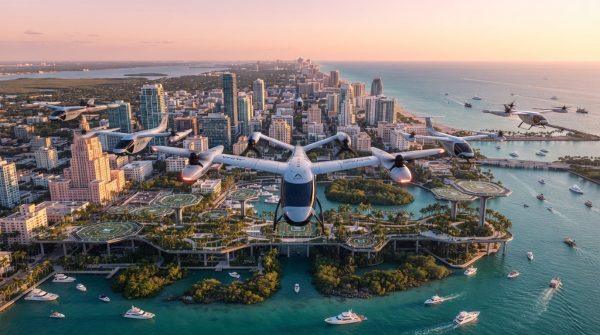
Florida is gearing up for a new era in urban travel, but the first passengers to hop on a flying taxi should expect to pay a premium. Governor Ron DeSantis recently confirmed that test flights will take off across central Florida in 2026, backed by two operational vertiports built for this purpose. However, he was candid about the initial costs: early fares will likely exceed what you'd pay for a standard Uber ride on the ground.
“I can't tell you that the first day will be as cheap as riding an Uber on the ground today, but I believe that as time goes on and people gain confidence, if demand is there, it will scale,” DeSantis said in an interview. That sentiment captures the cautious optimism surrounding the state's push into electric vertical takeoff and landing (eVTOL) aircraft.
The infrastructure is already taking shape. Testing facilities in Polk County, including the Auburndale area, are evaluating takeoff and landing maneuvers to ensure safety before any commercial rollout. The Federal Aviation Administration (FAA) is overseeing a pilot program that examines multiple operational scenarios to prevent airspace congestion, especially in busy corridors like Miami and Orlando.
Why the high price tag?
The economics of flying taxis are daunting. Massive capital investment in technology, vertiport construction, and rigorous certification standards mean that per-passenger costs will be steep at first. Industry analysts warn that infrastructure spending will require time to optimize pricing, and the first generation of commuters will be the ones to test whether the convenience justifies the cost.
Data from the Florida Department of Transportation shows that specialized facilities are working tirelessly to guarantee safety, but the financial reality is that advanced mobility demands prolonged investment without immediate returns. This raises questions about public resource allocation, especially when compared to traditional roadway maintenance. Municipal governments are coordinating joint studies to address acoustic and logistical impacts in densely populated urban sectors.
Despite the high entry price, demand projections show strong interest in niche applications like medical transport and corporate commutes before the service opens to the general public. This phased approach allows companies to refine routes and efficiency under strict regulatory oversight.
What to know before you fly
- Initial operating cost: Fares will exceed conventional ground transportation due to the heavy investment in technology and infrastructure.
- Specialized infrastructure: Testing facilities in Polk County are evaluating optimal conditions for takeoff and landing.
- Federal certification: The FAA supervises every phase of the pilot program to ensure passenger safety.
- Urban integration: The service aims to transform connectivity across Florida's most populated urban centers.
For now, the promise of flying taxis is real, but so is the sticker shock. As the state prepares its aerial infrastructure, the debate over affordability and accessibility continues. Will this become a mainstream mode of transport, or remain a luxury for the few? The next few years will tell.
Florida is also expanding its autonomous vehicle network, with Tampa joining the state's driverless zones, signaling a broader shift toward innovative transportation. And while flying taxis may seem futuristic, other parts of the world are already experimenting with vertical cities, like Hangzhou's 20,000-resident vertical city, which offers a glimpse into how urban living might evolve.
As Florida moves forward, the focus remains on safety, regulation, and eventually, making the service accessible to all. For now, the skies are open, but your wallet might need a moment to catch up.