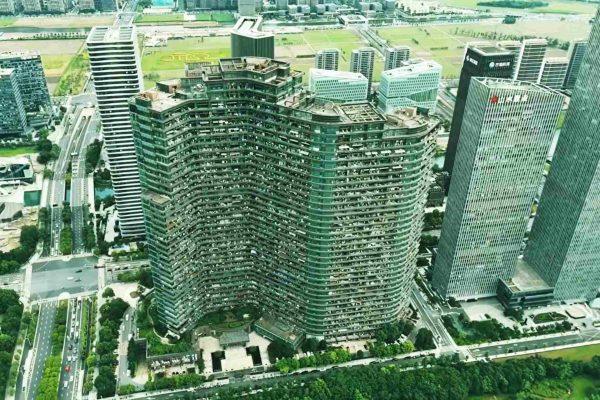
Imagine living in a building so large it functions as its own city—with thousands of neighbors, a supermarket, a gym, and even a swimming pool, all under one roof. That's the reality for up to 20,000 residents of the Regent International Center in Hangzhou, China. This 39-story, 206-meter-tall tower has become a global symbol of extreme urban density, challenging our notions of privacy and community in ways that feel both futuristic and unsettling.
For anyone who values personal space, the idea of sharing a building with 20,000 people might sound like a nightmare. Yet for the residents of this "vertical city," it's just another day. The sheer concentration of people transforms everyday interactions—elevator rides become crowded commutes, hallways buzz with constant activity, and shared spaces are never truly empty. This hyper-dense living arrangement has turned the building into a social experiment, one that blurs the line between public and private life.
A Social Paradox: Connected Yet Isolated
Living in such a mega-structure fundamentally changes how people interact. The building has become a hub for digital content creators and e-commerce live streamers, who thrive on the collaborative energy and built-in audience. But this constant human presence also means there's little room for solitude. Residents navigate crowded corridors and shared facilities at all hours, making privacy a rare commodity. It's a paradox: you're surrounded by people, yet you can feel more isolated than ever.
This dynamic echoes the experiences of many in Latin America's sprawling metropolises, where dense living is common but rarely reaches this extreme. In cities like México City or Bogotá, community is built through shared spaces and close quarters, but the scale here is unprecedented. The Regent International Center takes the concept of vecindad—that sense of neighborhood—and amplifies it to a dizzying degree.
The Claustrophobic Reality of Windowless Rooms
The most claustrophobic aspect of this vertical city lies in its internal layout. High demand has led to the informal partitioning of apartments into smaller units, many of which lack windows or natural ventilation. The cheapest rooms, renting for around 1,500 RMB per month, are essentially windowless boxes. Only those willing to pay over 4,000 RMB get access to balconies and sunlight. For many, this means living in a tight, dark space that heightens the feeling of being trapped in a concrete hive.
This lack of natural light and airflow can take a toll on mental health, a concern that resonates with urban planners worldwide. As cities grow denser, the challenge of maintaining livable conditions becomes more pressing. The Regent International Center serves as a cautionary tale about the limits of vertical living.
A Self-Contained Bubble
Originally designed by architect Alicia Loo as a high-end hotel, the building was adapted to provide an all-inclusive environment. Residents can find supermarkets, restaurants, internet cafes, barber shops, and even a swimming pool without ever leaving the premises. This self-sufficiency means the outside world is largely optional—a convenience that proved valuable during lockdowns, but also reinforces a sense of confinement. Home, work, and recreation all happen within a single enclosed perimeter, creating a bubble that can feel both liberating and suffocating.
This model of self-contained living is not unlike the housing challenges faced by many Latino communities, where affordability and space are constant struggles. While the scale is different, the underlying tension between community and privacy is universal.
Safety Concerns and Image Management
The extreme population density and continuous room subdivisions have raised serious concerns about fire safety, structural strain, and overcrowding. In response to criticism, the property management has hired public relations firms to reshape the building's image, portraying it as a vibrant community rather than a claustrophobic experiment. Despite these efforts, the Regent International Center remains a stark example of how extreme density can push social life and urban living to their limits.
As cities around the world look to vertical solutions for housing, this Chinese tower offers a glimpse into a possible future—one that is both fascinating and cautionary. For those of us in the Americas, where urban sprawl often takes precedence, the vertical city presents a different kind of challenge: how to build communities that are dense yet humane, connected yet private. The Regent International Center may be an extreme case, but it raises questions that urban planners from Buenos Aires to Los Angeles will need to answer.
In the end, this vertical city is a testament to human adaptability, but also a reminder of the importance of space, light, and the simple right to a window. As we continue to densify our cities, we must ensure that we don't lose sight of what makes a place livable—not just for 20,000 people, but for everyone.