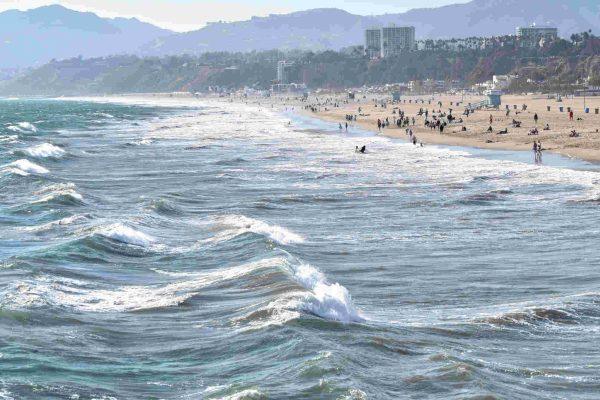
El Niño is back, and this time it's bringing a deep-ocean visitor that could reshape California's coastline for months. Scientists are tracking a massive Kelvin wave—a slow-moving bulge of warm water that travels eastward along the equator—that is set to lift sea levels along the Golden State's shores by as much as 30 centimeters (about a foot) on top of existing trends.
Unlike the choppy surface swells surfers chase, a Kelvin wave is a subsurface phenomenon. It forms when El Niño weakens the trade winds, allowing warm water that usually piles up in the western Pacific to slosh back toward the Americas. As this warm pool arrives, it expands—warm water takes up more space than cold—and that thermal expansion is what drives the sustained rise in sea level. The wave doesn't crash; it just sits there, raising the ocean's surface for weeks at a time.
What this means for California's coast
The projected 30-centimeter rise is significant, especially when layered on top of the roughly 20 centimeters of sea-level rise already attributed to climate change. That combination, experts warn, will turn ordinary high tides into potential flood events and make winter storms far more destructive. Beaches that have already been narrowing will face accelerated erosion, and low-lying neighborhoods—from San Diego to Eureka—could see water creeping into streets and homes.
In response, California's coastal agencies have moved into emergency mode. They're fast-tracking permits for seawalls and other protective structures, reinforcing dunes, and urging local governments to update their flood-response plans. The state's Coastal Commission has issued a stark advisory: prepare for the possibility of cyclonic storms and severe winter weather in the coming months. It's a familiar scenario for those who remember the devastating El Niño winters of 1982-83 and 1997-98, but with a climate-change twist that makes the stakes even higher.
“We're not just dealing with a single storm event,” said a spokesperson for the California Coastal Commission. “This is a prolonged elevation of the ocean's baseline, and that changes the math for every coastal community.”
Beyond California: a Pacific-wide phenomenon
The Kelvin wave's influence isn't confined to the U.S. West Coast. Its effects ripple across the entire Pacific basin, affecting sea levels and weather patterns from México to Chile. In Latin American coastal cities like Acapulco and Valparaíso, similar—if less dramatic—sea-level anomalies are being monitored. For the region's fishing communities and port operators, the warmer waters can disrupt marine ecosystems, shifting fish populations and affecting livelihoods.
This is a reminder that El Niño is not a single-country event. It's a hemispheric weather engine that connects the fates of communities from Baja California to the Patagonian coast. As Southern California faces new surf threats from the same system, the need for cross-border cooperation in climate adaptation becomes ever more urgent.
Preparing for the long haul
State officials emphasize that preparation is the best defense. “We can't stop El Niño, but we can reduce its impact,” said a representative from the Governor's Office of Emergency Services. That means investing in natural buffers like restored wetlands, which absorb wave energy, and ensuring that infrastructure—from sewage systems to power grids—can withstand flooding.
For residents, the advice is practical: know your evacuation routes, secure your property, and stay informed. The recent approval of a beachfront resort in Sand City with major dune restoration shows that development and coastal resilience can go hand in hand, but it requires foresight.
As the Kelvin wave makes its slow march across the Pacific, California—and the entire Latin American Pacific coast—watches and waits. The ocean is rising, not just in a distant future, but right now, and this El Niño is a stark reminder that the climate crisis is not a distant threat. It's here, on our shores, and it's demanding our attention.