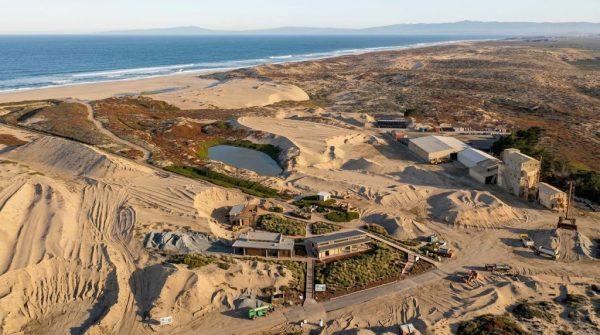
In a decision that could reshape the tiny Monterey County enclave of Sand City, California regulators have given the green light to a rare beachfront hotel development. The project, known as the Collections Resort, will bring 100 rooms and 25 tent cabins to an eight-acre site along Highway 1, but it comes with a significant environmental price tag: private developers will fund a multi-million-dollar cleanup of decades-old industrial mining debris that has scarred the shoreline.
Sand City, home to just 323 residents, has long struggled with the legacy of sand mining that operated along its coast until the early 1990s. The extraction process—dredging, washing, and sifting sediment—left behind massive concrete slabs and other debris that now cover roughly 80% of the municipal coastline. City leaders, including Mayor Mary Ann Carbone and City Manager Vibeke Norgaard, have spent their 35-year tenures trying to remediate the damage, but the town's limited budget, reliant on sales tax from big-box stores like Costco and Target, has made progress slow.
Now, with the California Coastal Commission's approval, the project promises to transform the degraded landscape. Developers will remove an 800-foot concrete berm, relocate Tioga Avenue further inland to prevent erosion, restore 22 acres of native dune habitat, and construct a one-mile segment of the California Coastal Trail. Public amenities will include boardwalks, restrooms, and beach access parking near Monterey Bay.
A project shaped by compromise and community support
The approval comes after more than a decade of negotiations. An earlier proposal for a 340-room resort was rejected, and the current scaled-down version prioritizes public access to the dunes. Project manager David Watson called it "a project you may never see again," reflecting the rarity of new beachfront development along California's heavily regulated coast.
Environmental groups have offered cautious support. Jennifer Savage, a policy expert with the Surfrider Foundation, said she "reluctantly" backed the protective package, while Coastal Commission manager Kevin Kahn praised the potential for the dune space. The project also includes protections for native species like the snowy plover, and will work with California American Water and Monterey-Salinas Transit to ensure public access and habitat preservation.
Notably, the site's industrial mining history exempts it from some restrictions under the Coastal Act of 1972, allowing development in an Environmentally Sensitive Habitat Area. However, ongoing civil litigation involving developer John King, reported by the San Luis Obispo Tribune, adds a layer of uncertainty. King Ventures, based in San Luis Obispo, has 40 years of experience operating hospitality properties on the Central Coast.
Broader impact on the Monterey Peninsula
The Collections Resort is part of a wave of hospitality investments across Monterey County. A 215-room Marriott Courtyard recently opened just a block from the site, and the city council has approved converting a commercial building into a boutique hotel. Another eco-resort, shaped like a seashell, has been delayed due to land ownership disputes.
For small coastal towns like Sand City, these public-private partnerships offer a way to fund infrastructure improvements that would otherwise be unaffordable. The resort will generate more than $10 million in public improvements, including the dune restoration and trail construction. As rising seas threaten coastal communities, such projects are increasingly seen as a way to balance economic development with environmental resilience.
For the Latino community in the region, the project also holds cultural significance. Monterey County has a deep Mexican-American heritage, and the coastal areas have long been places of recreation and family gatherings. The new public access points and restored dunes will offer more opportunities for residents and visitors to connect with the shoreline, much like Catherine Breed's record swim highlighted the beauty of California's coast.
As construction is expected to begin soon, the town of Sand City stands on the brink of change. The resort will bring jobs and tourism, but it also carries the weight of a promise: to heal a landscape that industrial extraction left broken. Whether that promise is fully kept will depend on the developers' commitment and the community's vigilance.