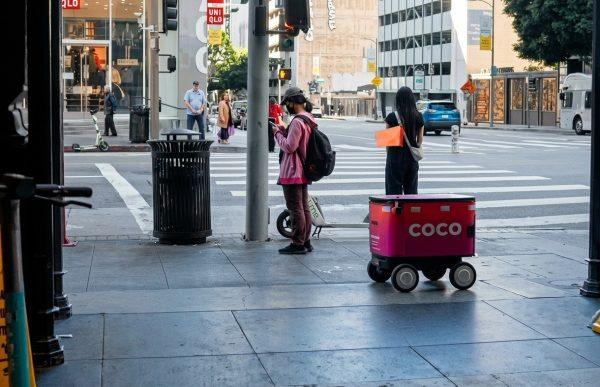
On the sidewalks of Los Angeles, Miami, and Chicago, a fleet of about 1,000 delivery robots from Coco Robotics has taken on a new role: they now serve as digital guides for visually impaired pedestrians. Through a partnership with BlindSquare, a GPS app widely used by the blind community, these robots share real-time data about obstacles that conventional maps miss—from a poorly parked electric scooter to a broken sidewalk.
How It Works: Robots as Living Maps
The system is deceptively simple. As Coco’s robots navigate city streets for their usual delivery runs, their cameras and sensors record every irregularity. That information is processed and sent to BlindSquare users, who receive a voice alert in their language—the app supports 26 languages—about 10 meters before reaching the hazard. It’s a constantly updated map, far more precise than municipal databases that often lag behind.
The idea originated in Helsinki, Finland, where developer Ilkka Pirttimaa noticed that robots and blind people face the same challenges on public roads. “Sidewalks are spaces where blind people are sometimes afraid to go,” Pirttimaa explained. By sharing the same physical space, delivery robots encounter the same navigation problems as a pedestrian with a visual disability. The system categorizes hazards by persistence: a fallen object might be marked for six hours, while roadwork stays in the system for weeks. And the exchange is bidirectional—if a pedestrian notices an obstacle is gone, they can report it through the app, automatically updating the route for Coco’s robots.
Beyond Convenience: Building Smarter Cities
This technology is already transforming urban infrastructure. Zach Rash, CEO of Coco, noted that their data helps identify critical points where small interventions—like installing a curb ramp—can unlock connectivity for entire neighborhoods. That’s exactly what happened in Venice Beach, California, where data from the robots led to a ramp installation that improved access for everyone.
The collaboration also looks ahead to smart traffic lights. In Helsinki, robots can already virtually “press” pedestrian crossing buttons, a capability now extended to BlindSquare users. This kind of automation isn’t just about convenience; it’s about making cities safer and more accessible for all.
For Latino communities in cities like Los Angeles and Miami, where many visually impaired residents navigate daily life, this technology offers a tangible improvement in mobility and independence. It’s a reminder that innovation can come from unexpected places—like a delivery robot rolling down your block. As cities across the Americas and the diaspora continue to grow, tools like these could help bridge the gap between infrastructure and inclusion.
For more on how technology is reshaping urban life, check out our coverage of California’s new fines for autonomous vehicle makers and the rise of Latino cuisine in Los Angeles.