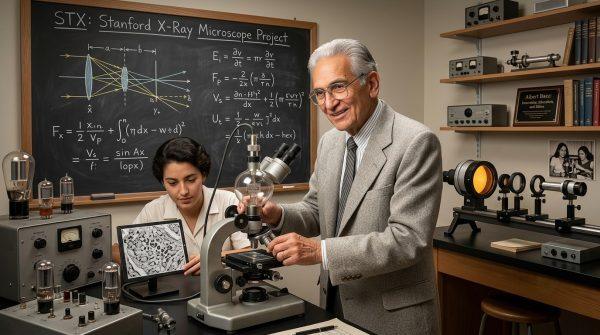
When we talk about Latino contributions to American science, Albert Baez’s name should be as familiar as any. Born in Puebla, México, in 1912, Baez fled revolutionary violence with his family to Brooklyn, where he would go on to earn a PhD in Physics from Stanford University in 1950. His invention of the X-ray microscope in the late 1940s transformed medicine and astronomy—and his refusal to work on military projects defined a life of ethical innovation.
Baez’s X-ray microscope allowed scientists to see cellular structures invisible to standard light microscopes, revolutionizing early cancer diagnostics. The same optical principles he developed now underpin instruments used to explore deep space. The American Physical Society has extensively documented his work, which set global standards for precision optics.
But Baez was more than a lab scientist. He taught at MIT and later at the University of Baghdad, bringing physics to students who might never have encountered it otherwise. He served as president of Vivamos Mejor/USA, an organization that channels resources to rural communities in Latin America. His pacifism was unwavering: during the postwar era, he turned down lucrative military contracts, insisting that science must serve humanity, not warfare.
A Legacy That Sang
Perhaps Baez’s most visible impact came through his daughters. Joan Baez and Mimi Fariña grew up in a home where activism was as natural as breathing. Joan became the voice of the 1960s folk protest movement, marching with Martin Luther King Jr. and singing against the Vietnam War. Mimi co-founded Bread & Roses, a nonprofit that brings live music to prisons and hospitals. Both credit their father’s example of moral courage and intellectual curiosity.
“He taught us that you can be both brilliant and kind,” Joan Baez once said in an interview. “That science without conscience is just another weapon.”
Baez’s story is a reminder that the immigrant experience is not a monolith. He arrived speaking no English, faced discrimination, and yet rose to the top of his field. His journey from Puebla to Brooklyn to Stanford mirrors the broader arc of the American experiment—but it also reflects a specifically Latino commitment to community and justice. As the U.S. marks its 250th anniversary, Baez’s life offers a counter-narrative to anti-immigrant rhetoric: here was a man who gave the country some of its most vital scientific tools and raised two of its most beloved artists.
Today, his optical inventions continue to enable breakthroughs in cellular medicine and astrophysics. But his real legacy may be the example he set for young Latinos: that technical excellence must be paired with civic responsibility. In an era when scams target immigrant communities and stories of immigrant success are often reduced to stereotypes, Baez’s life is a nuanced, powerful testament to what happens when a brilliant mind refuses to separate science from humanity.
His teaching stints in Iraq and across the Americas show that knowledge knows no borders. And his daughters’ activism proves that the values of justice and compassion can be passed down like heirlooms. Albert Baez died in 2007, but his X-ray microscope still peers into the invisible, and his spirit still challenges us to build a more equitable world.