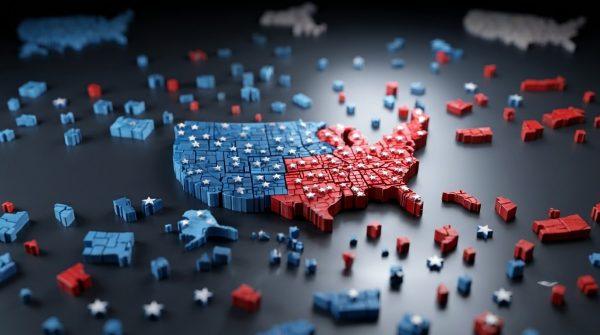
Wisconsin has long been a political bellwether, but today it stands as the most polarized state in the nation—a place where every civic debate, every opinion, and every vote feels like a battle. For a quarter century, this Midwestern state has been the ultimate battleground, with presidential elections decided by razor-thin margins. According to the Wisconsin Elections Commission, voter turnout regularly exceeds 70% of registered voters, a testament to the intensity of engagement—and the depth of division.
Since 2000, only Barack Obama has won the state by more than a single percentage point, and that happened twice. In every other election, the margin has been under one point, making Wisconsin a mirror of the nation's institutional tensions. But the closeness of the vote doesn't reflect moderation; rather, it fuels extremism. A recent study by the University of Wisconsin Survey Center found that more than half of voters view the opposing side as a direct threat. That perception transforms every political discussion into a potential conflict, whether at a family dinner, a neighborhood meeting, or a town hall.
A legacy of contrasts
Wisconsin's political history has never been bland. The state gave us progressive icon Robert La Follette, the father of the Progressive Movement, and later, anti-communist crusader Joseph McCarthy. In recent decades, voters have swung between liberal stalwarts like Russ Feingold and Tammy Baldwin and conservative figures like Scott Walker and Ron Johnson. This alternating pattern reflects a deeply divided electorate that refuses to settle into a comfortable middle ground.
Under Governor Tony Evers, a Democrat, the state has seen a constant tug-of-war between the executive branch and a legislature that has often been controlled by Republicans. This gridlock is not just a political inconvenience; it's a daily reality for residents. State Representative Francesca Hong, a Democrat from Madison, acknowledges this history and uses it to rally support. At a recent rally in Appleton, she told supporters, "Wisconsin is a democratic laboratory. We debate without truce in every election cycle." Her words capture the spirit of a state where politics is not a spectator sport but a full-contact endeavor.
Electoral dynamics and civic confrontation
The numbers tell the story: presidential margins below one point in almost every election since 2000; alternating support between liberal and conservative candidates; and rallies that draw crowds of over 200 people, as seen in Appleton last weekend when Hong gathered supporters. Every political opinion generates immediate friction in public spaces, and the state has earned a reputation as a petri dish for both progressive and conservative ideologies.
Campaign strategists know that messaging in Wisconsin requires millimeter precision. A single misstep can alienate a key constituency or energize the opposition. Candidates must navigate a divided electorate while trying to secure victories with narrow margins. The stakes are high, and the pressure is relentless.
What lies ahead
Political analysts see no end to the partisan tension. The upcoming elections will likely require record budgets for advertising and grassroots mobilization, reflecting the constant wear and tear on public institutions. Party leaders are searching for new ways to connect with independent voters, hoping to rebuild bridges of dialogue in a state where every administrative decision generates controversy.
For Latinos in Wisconsin, this polarization is not abstract. The state's growing Latino community, concentrated in Milwaukee and other urban centers, finds itself navigating a political landscape where their voices matter more than ever. Issues like immigration, education, and economic opportunity are front and center, and the community's engagement could tip the balance in future elections. As the state continues to be a national benchmark, the Latino vote is becoming a crucial piece of the puzzle.
Wisconsin's story is a reminder that democracy is not always tidy. It is messy, contentious, and often uncomfortable. But it is also a testament to the power of civic engagement. Whether you're a progressive in Madison or a conservative in Waukesha, your opinion matters—and in Wisconsin, it will always spark a fight.