Think about your five closest friends. Where did you meet them? Do you share the same background? What do they do for a living? How do their points of view compare to yours? Do you ever disagree?
Our friends are a foundational part of our survival. They show up for us in hard times, celebrate with us when it’s all alright. Especially when you’re queer—especially if your family doesn’t fully support who you are—it’s our friends who become our chosen family, that self-constructed homebase needed to live full lives.
But so often our friends reflect back at us the truths we’ve already come to understand. They work in the same industry as we do. They have the same opinions as we do. They are from the same part of the world as our families.
If you don’t have friends that are different from you, it’s easy to get stuck inside an echo chamber of your own existence.
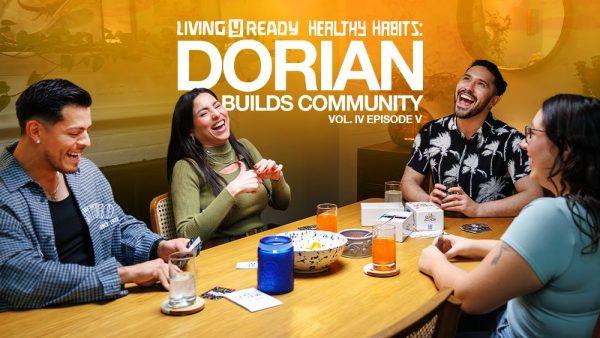
In the next episode of Living Y Ready, Dorian has friends over for a game night and talks to us about their varied personalities and walks of life.
“I think having diverse friends, and having different viewpoints, gives you a full 360-look at everything,” he says on camera.
Where previous episodes this season have outlined healthy habits like his morning routine, cooking healthy, and working out, this final chapter displays how having community is another quintessential element to a healthy, fulfilled life.
Dorian’s Journey with HIV
Dorian has been living with HIV for a few years now, and it’s become an important piece of his identity.
“Living with HIV is something that I bring up with friends, especially when we just become friends, because it’s part of my DNA, it’s part of who I am, it’s my identity,” he says. “A lot of times, they hear my story, and they’re like, I also can overcome something that I see as … scary.”
Not all of Dorian’s friends live with HIV. They don’t know what it was like to get diagnosed. They weren’t there when he told his family, nor did they have to disclose such news to their own. They don’t have to bring up HIV-status on dates. They don’t have to worry about a particular medicine staying affordable.
Dorian’s friends have challenges of their own, perhaps different in scope, but just as meaningful. So, what they do understand is that Dorian overcame a serious challenge—and continues to overcome its effects every day.
Remembering our own struggles, we more readily empathize with someone else’s struggles. Moreover, a friend’s resilience can inspire us to be resilient, too, when it’s our turn to overcome.
Some friends speak different languages with their parents. Some celebrate different traditions. Some have bigger families or deal with medical issues you don’t have. Other friends might even vote against your values at the ballot box.
Is it possible to share things in common with someone who is seemingly so “different” on paper? But maybe you have the same morning routine; maybe you have the same work ethic; maybe you hate the same movie; maybe you’re the same size and share clothes. Discovering those little flowers of unity—it makes these kinds of friendships so powerful, so fruitful.
For Latino audiences, this resonates deeply. Our communities are not monoliths—from the portable roots we carry in our bags to the varied ways we navigate identity across the diaspora. Friendships that cross borders—whether geographic, cultural, or ideological—help us see the full spectrum of our own experiences.
As Dorian’s story shows, the most meaningful connections often come from those who challenge our assumptions and broaden our world. So, take a look at your circle: are you surrounded by mirrors, or windows?