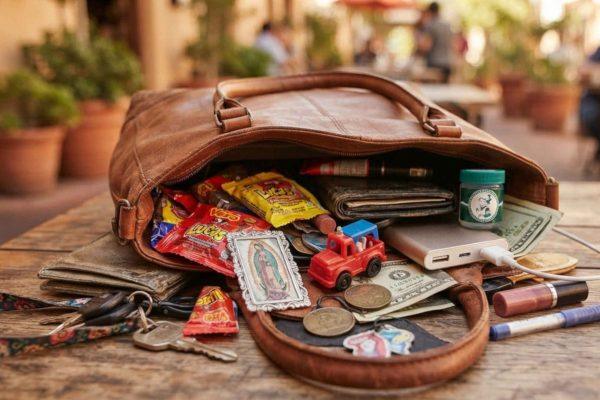
Open a Latino bag on any street corner, and you might find a small altar, a candy stash, and a phone charger that's seen better days. It's a scene that plays out across México, Bogotá, Lima, and the diaspora—and it's become a quiet source of pride, humor, and identity.
For many of us, the bag is not just a practical item. It's a personal museum. It holds the things that keep us grounded: a Virgencita medal, a packet of chamoy, a crumpled bill that's been folded into a lucky charm. These objects travel with us from the mercado to the office, from the metro to the airport, and they tell a story that words often can't.
Faith, flavor, and a little bit of luck
In many Latino households, faith and everyday life are inseparable. That's why it's no surprise to find a holy card of the Virgin of Guadalupe or San Martín de Porres tucked next to a lip balm and a set of keys. For some, it's a family heirloom; for others, it's a daily reminder of a promise or a prayer. These items aren't just decorative—they're a form of protection, a way of carrying home with you.
But faith isn't the only thing we pack. Food is a big one. From mango con chile to tamarindos, from cajeta to churros, our bags often double as a snack stash. It's a habit that makes sense: we never know when we'll need a taste of home, or when a friend might need a little pick-me-up. Sharing a candy from your bag is practically a love language.
And then there's the cargador—the portable charger. It's become a running joke in our community: we always carry one because we're always on the go, always connected, always ready. It's a small symbol of our energy and our refusal to slow down.
More than just stuff
These items might seem trivial, but they carry deep meaning. A coin from your hometown, a bracelet from a festival in Oaxaca, a keychain from that trip to Cartagena—each one is a memory, a connection to a place and a people. When we open our bags, we're not just showing what we carry; we're showing where we come from.
Social media has turned this into a shared joke. Videos of people emptying their bags to reveal a mini-altar, a stash of picante candy, and a well-worn escapulario have gone viral, and for good reason. They capture something real: our culture is not something we leave at home. It travels with us, in our pockets and our purses, across borders and generations.
This isn't about being stereotypical. It's about celebrating the ways we stay connected to our roots, even when we're far from them. Whether you're in a hidden Mexican colonial town or a bustling city like Houston, the contents of a Latino bag can make you feel like you're never really alone.
And it's not just about the objects themselves. It's about the stories they tell. That Virgencita was your grandmother's. That chamoy is from the corner store in your barrio. That charger has seen you through late nights and early mornings. Our bags are a diary, written in small, everyday things.
So the next time you see someone rummaging through their bag for a dulce or a medalla, remember: it's not just stuff. It's a piece of home, a piece of us. And that's something worth carrying.