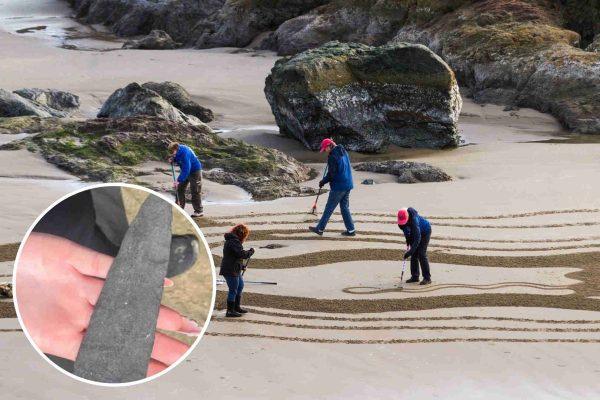
What started as a routine search for shark teeth turned into a once-in-a-lifetime discovery for Brooklyn Rolph, a student at Mary Baldwin University. On a field trip to Virginia's barrier islands, she spotted a curious stone half-buried in the sand—and it turned out to be an ancient Indigenous tool, thousands of years old.
The ecology excursion was meant to study coastal plants, but the group had only about forty minutes before high tide would swallow the beach. Rolph, scanning the ground for shark teeth, noticed the carved rock and picked it up. Her professors immediately recognized its significance, and what followed was a rapid chain of events that would place the artifact in the hands of state archaeologists.
A rare find in a shifting landscape
Experts from the Virginia Department of Historic Resources identified the object as a Lehigh/Koens-Crispin point, a type of tool used by Indigenous peoples between 3,000 and 4,500 years ago. The point, roughly 15 centimeters long, was in remarkably good condition—especially given the constant wave action that erodes everything in that environment.
“It’s incredibly rare to find something this intact in a place where the tide is always moving,” said a spokesperson for the department. The tool was likely used for hunting or cutting, and its presence on the island suggests that Indigenous communities once traveled through or camped in the area.
For Rolph, the moment was surreal. “I just saw something that didn’t look like a regular rock,” she told local media. “I picked it up and showed my professors, and they were amazed.” Her classmates were equally stunned, and the discovery quickly became the talk of the university.
Preserving cultural heritage
Because the find occurred within a state nature reserve, the artifact had to be turned over to the Department of Conservation and Recreation on the same day. Rolph and her classmates understood the legal protections in place, and the tool was transferred to the Virginia Department of Historic Resources for further analysis and long-term conservation.
This isn’t the first time a student has stumbled upon history. In a similar vein, a quick-thinking Minnesota man saved 19 students from a runaway bus, showing how ordinary moments can turn extraordinary. And while that story involved a different kind of heroism, both remind us that unexpected discoveries can happen anywhere.
The artifact will now be studied by archaeologists, who hope to learn more about the Indigenous peoples who once inhabited the region. For the Latino community, this story resonates with a broader appreciation for ancestral heritage—much like the cumbia tumbada hit that celebrates hidden love, or the tragic loss of Venezuelan musician Gus Ormo, which reminds us of the fragility of life and the importance of preserving memory.
For now, Brooklyn Rolph’s discovery stands as a testament to the power of curiosity and the value of protecting our shared history. It’s a story that will be told for years to come—not just at Mary Baldwin University, but across the state of Virginia.