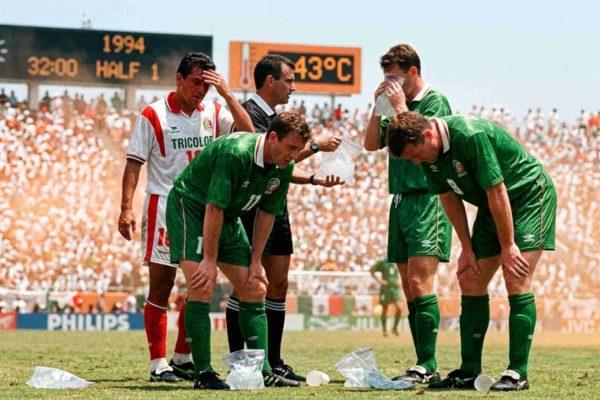
Thirty-two years ago, on June 24, 1994, the Citrus Bowl in Orlando became the stage for what remains the hottest World Cup match in history. Mexico faced Ireland under a brutal sun that pushed pitch temperatures past 43 degrees Celsius, turning a group-stage game into a crisis that would forever alter how soccer handles extreme heat.
The match kicked off at 12:30 p.m., a time chosen to satisfy European television audiences and dodge Florida's notorious afternoon thunderstorms. But that decision ignored the human cost. Irish players, accustomed to cool, damp climates, found their high-pressing style impossible to sustain. Forward John Aldridge later admitted that maintaining their usual pace felt simply impossible under the suffocating conditions. Meanwhile, Mexican defenders like Claudio Suárez acknowledged that the heat gave them an edge, helping El Tri secure a 2-1 victory.
But the real chaos unfolded in the stands. Thousands of Irish fans, many unaccustomed to such intensity, turned pale and gasped for air. They scrambled to find refuge under stadium pipes that sprayed water, desperately trying to cool down. Over 100 people collapsed that day, a direct result of the unforgiving heat and the ill-conceived kickoff time. The spectacle had taken precedence over safety, and the consequences were immediate.
A Wake-Up Call for FIFA
That failed experiment served as an urgent wake-up call for organizers and FIFA. It proved that the health of players and fans must never be sacrificed for broadcast schedules. The lessons from Orlando forced a fundamental shift in how the World Cup approaches extreme weather. Today, mandatory three-minute hydration breaks are standard in each half during high-heat matches. Stadiums now incorporate roofs to provide essential shade, and scheduling carefully avoids kickoff times before 6 p.m. in critical zones like Miami.
These measures are not just bureaucratic tweaks; they are a direct response to the trauma of 1994. As the planet has warmed by approximately 0.7 degrees Celsius since that tournament, constant hydration monitoring and proper acclimatization have become pillars of athletic preparation. The World Cup has evolved, transforming that chaos in Orlando into an essential guide for protecting the future of football within an increasingly challenging climate.
For Mexican fans, the match remains a point of pride and a cautionary tale. It's a reminder of how faith and fervor can carry a team through adversity, but also of the need for structural change. As the World Cup returns to North America in 2026, the legacy of that scorching day in Orlando will be felt in every hydration break and shaded seat. The game has learned its lesson, and the players—and the fans—are safer for it.