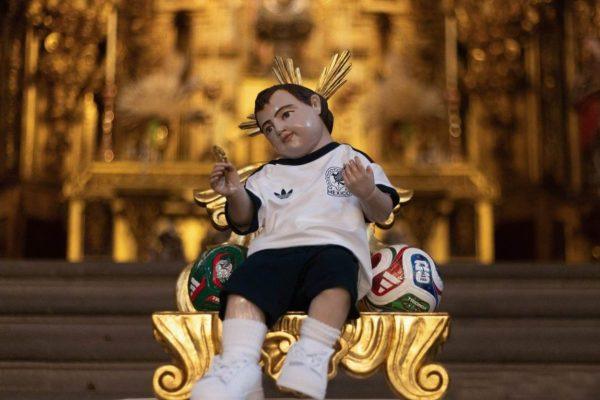
As Mexico prepares to co-host the FIFA World Cup alongside Canada and the United States, a different kind of pilgrimage is unfolding inside the Metropolitan Cathedral of Mexico City. Thousands of faithful and curious visitors are gathering around a statue of the Baby Jesus dressed in the official green jersey of the Mexican national soccer team, praying for a miracle that could carry El Tri to glory. This display, which has sparked both devotion and debate, is a vivid example of how Mexican folk Catholicism continues to evolve at the intersection of faith and national passion.
The tradition of dressing Niño Dios figures in clothing that reflects everyday hopes and occupations dates back decades, with families adorning these statues as doctors, police officers, or pilgrims to pray for safety, health, or employment. The soccer-themed version first appeared during the 1970 World Cup, the first time Mexico hosted the tournament. This year, the statue gained prominence after a dispute in a local parish, where a priest banned the jersey as disrespectful. The controversy ignited a wave of popular demand, ultimately leading church authorities to welcome the figure into the nation's primary cathedral.
A Cultural Language of Unity
For many Mexicans, the image of the Christ Child in the national team's colors is more than a quirky display—it's a powerful symbol that unites two pillars of Mexican identity: Catholicism and soccer. In a country where religious diversity is growing and younger generations are rethinking traditional institutions, the World Cup serves as a secular ritual that temporarily bridges political and economic divides through shared pride. As one devotee told local media, “If we can pray for a job or for health, why not pray for a goal?”
This practice is not unique to Mexico. Across Latin America, fans in Brazil, Argentina, and Colombia occasionally drape national scarves or jerseys over religious statues during major tournaments. However, Mexico's tradition stands out for its systematic and ritualistic nature. Unlike spontaneous displays elsewhere, the Soccer Baby Jesus has become a deeply rooted devotional institution, where popular faith successfully reinterprets formal Church doctrine to adapt ancient spiritual practices to modern cultural events.
The theological debate surrounding the statue is intense. Critics argue that placing a corporate sports jersey on a representation of Christ risks trivializing the divine, warning that sacred symbols should not be subordinated to nationalism or commercial interests. Supporters counter that the jersey is not a reduction of Christ's status but a way to intertwine every aspect of daily life—including communal entertainment—with the spiritual world. This tension reflects broader questions about inculturation and the boundaries between sacred devotion and cultural assimilation.
For those who visit the cathedral, the statue is a tangible link between their faith and their hopes for the national team. If Mexico manages a historic run in the knockout stages, many will credit the miracle to more than just athletic strategy. As one pilgrim put it, “The little green-jerseyed icon in the cathedral had a hand in it.”
This story is part of a larger narrative of how Latin American cultures blend faith and soccer. In Colombia, for example, the national team's jersey has become a political flashpoint, as seen in Colombia's World Cup Jersey Becomes a Political Flashpoint in Presidential Race. Meanwhile, Mexico's own soccer history is marked by dramatic highs and lows, from the Aztecazo to the 7-0 Chile humiliation, chronicled in Mexico's Worst Defeats: From the Aztecazo to the 7-0 Chile Humiliation. And for fans looking to experience the World Cup on a budget, there are affordable adventures across Mexico, the US, and Canada, detailed in World Cup 2026 on a Budget: Affordable Adventures in Mexico, US, and Canada.
As the tournament approaches, the Soccer Baby Jesus remains a testament to the resilience of Mexican folk Catholicism and its ability to adapt ancient traditions to contemporary life. Whether or not El Tri achieves a miracle, the statue has already sparked a conversation about identity, faith, and the unifying power of soccer in a modernizing society.