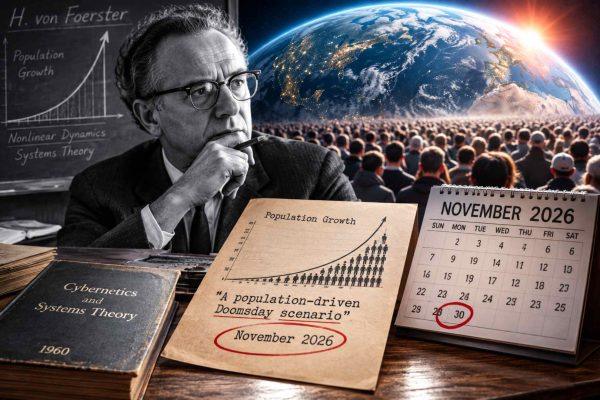
In 1960, a paper in the journal Science made a startling prediction: human civilization would reach its breaking point on Friday, November 13, 2026. The authors—Heinz von Foerster, Patricia M. Mora, and Lawrence W. Amiot, all at the University of Illinois—built a mathematical model that tied the end of days to the explosive growth of the global population. Now, with that date just months away, the study has resurfaced in online conversations, sparking both curiosity and debate.
A formula for the end of the world
The team's equation was simple in concept but radical in implication: as the human population grows exponentially, it would eventually outstrip the planet's capacity to sustain it, leading to a sudden and catastrophic collapse. In 1960, Earth held about 3 billion people; today, we're past 8.3 billion. The authors argued that unlike natural systems where growth slows as resources dwindle, human ingenuity—through technology and agriculture—would keep pushing the limits until a sharp, unavoidable breakdown.
This wasn't a prophecy from a mystic or a sci-fi novel. It was a peer-reviewed scientific hypothesis, grounded in the mathematics of growth and limits. Yet, as with many such predictions, the exact date has taken on a life of its own in popular culture, especially on social media where clips and posts about the study have gone viral.
Von Foerster's early warning on AI
Part of the renewed interest stems from the reputation of Heinz von Foerster, an Austrian-American physicist and cyberneticist who was decades ahead of his time. Long before chatbots and automated decision-making became part of daily life, von Foerster warned about the dangers of confusing machine output with human thought. In the 1990s, he argued that assuming artificial intelligence possesses human-like understanding simply because it performs complex tasks was a fundamental error—one that could have dire consequences for humanity.
His foresight is striking. Today, we see algorithms shaping elections, automating jobs, and even providing companionship. The cognitive traps he identified are now central to debates about AI safety and ethics. It's no wonder that his demographic doomsday formula is being revisited with fresh eyes.
Modern demographics tell a different story
Despite the anxiety surrounding the 2026 date, current demographic models paint a less apocalyptic picture. The United Nations projects that the global population will peak at around 10.3 billion in the 2080s, then gradually decline. This is due to falling birth rates in many regions, including Latin America, where countries like México, Brazil, and Argentina have seen significant fertility drops over the past decades. Agricultural innovations and urbanization have also eased some of the resource pressures that von Foerster's model assumed would be insurmountable.
Still, the underlying concerns about sustainability and the limits of growth remain relevant. Climate change, resource depletion, and environmental degradation are real challenges, even if the exact doomsday date was off. The study's core message—that human systems can't grow forever on a finite planet—resonates with contemporary discussions about climate policy and sustainable development.
For Latin American audiences, these themes hit close to home. The region is on the front lines of climate change, from the Amazon's deforestation to water shortages in cities like Bogotá and México City. The intersection of population dynamics, technology, and environmental limits is not an abstract academic exercise; it's a lived reality.
As we approach November 13, 2026, it's worth remembering that von Foerster's work was as much about human behavior as it was about mathematics. He saw the dangers of our collective choices—both in how we grow and in how we build machines that mimic our thinking. Whether or not the world ends on that Friday, his warnings about the perils of unchecked growth and misplaced trust in technology are as timely as ever.
For more on how technology and culture intersect, check out our coverage of Shakira's kids studying music with a Venezuelan teacher and the climate-driven spread of chikungunya. And for a look at how AI is shaping entertainment, see Robert Downey Jr.'s debut as Doctor Doom.