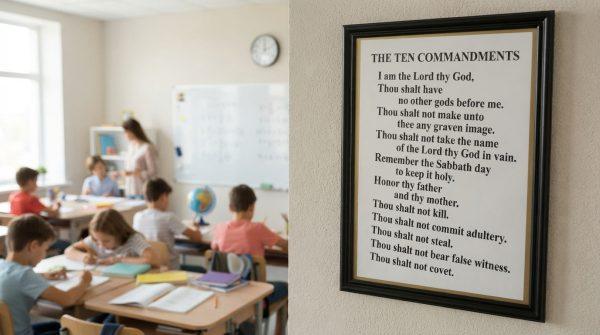
Texas families have taken their fight against a state law mandating the Ten Commandments in public school classrooms to the U.S. Supreme Court. The petition, filed with backing from civil rights organizations, argues that the requirement violates the First Amendment's Establishment Clause, which prevents the government from favoring one religion over another.
The law, known as Senate Bill 10, went into effect last September, requiring all public schools from kindergarten through high school to display the Ten Commandments in visible areas. Parents and advocacy groups, including the American Civil Liberties Union, contend that this mandate pressures a captive audience of students and creates an environment of religious favoritism.
A legal battle with deep roots
This is not the first time such displays have been challenged. In 1980, the Supreme Court struck down a similar Kentucky law, ruling that posting the Ten Commandments in classrooms lacked a secular legislative purpose. That precedent looms large as the current case makes its way through the courts.
Supporters of the Texas law argue that the Ten Commandments are historically significant and have influenced American legal traditions. They see the displays as educational and cultural, not strictly devotional. But plaintiffs' attorneys counter that permanent displays interfere with the religious upbringing of children and send a message of exclusion to students of minority faiths or no faith at all.
The families involved come from a range of backgrounds—Christian, Jewish, Hindu, Bahá'í, Unitarian Universalist, and non-religious—reflecting the diversity of the Lone Star State. Their legal team emphasizes that public schools must remain neutral on matters of doctrine, a principle they say is essential to protecting the rights of all students.
Americans United for Separation of Church and State, which is supporting the challenge, warns that the mandate stigmatizes students from religious minority groups. The organization argues that the constant presence of religious precepts alters the neutral academic environment that federal law requires.
Meanwhile, state education officials defend the measure, noting that no student is required to participate in religious rites. But critics, citing reports from the U.S. Department of Education, argue that the mere visual presence of the texts constitutes a form of indirect indoctrination that compromises students' freedom of conscience.
The controversy has turned Texas into a focal point for a nationwide debate over the boundaries between religion and public education. Neighboring states like Louisiana and Arkansas are watching closely, as their own policies could be affected by the Supreme Court's decision.
For Texas families, the stakes are personal. They see this as a fight not just about posters on walls, but about the kind of society they want their children to grow up in. As the case moves forward, the highest court in the land will have the final say on whether the Ten Commandments belong in every classroom.
This legal battle comes amid other challenges facing Texas communities, including federal penalties on SNAP benefits and concerns over highway expansion plans. The outcome of this case could have lasting implications for how religion is handled in public schools across the country.