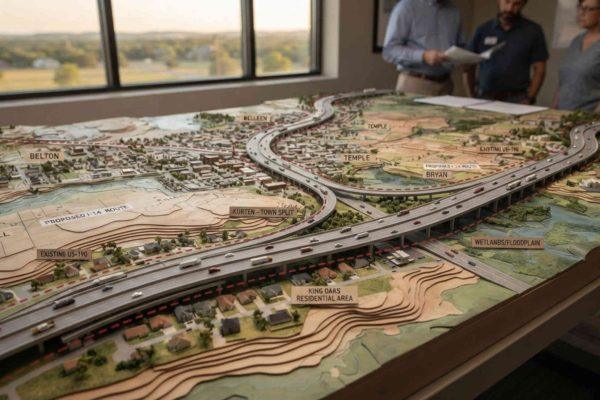
In Central Texas, a proposed interstate highway is stirring deep unease among homeowners who fear their properties could be swallowed by the project. The Texas Department of Transportation (TxDOT) is studying a roughly 125-mile corridor between Bell and Walker counties for the future I-14, a route that could eventually connect the region to a broader national network. But for families in communities like King Oaks and Kurten, the uncertainty is already taking a toll.
TxDOT officials stress that the current maps show "preliminary corridors" that are intentionally wide—about a mile across—to allow engineers to evaluate different alignments and minimize impacts. They insist the actual highway footprint would be much narrower, similar to a standard interstate. Yet that reassurance has done little to calm residents who see their homes, farms, and even a family cemetery potentially in the path of the new road.
Community concerns and environmental worries
At recent public meetings, residents have voiced fears that the highway could split neighborhoods, create physical barriers, and disrupt sensitive ecosystems. Wetlands, floodplains, and grazing lands are all in the crosshairs, according to local advocates. One emotional flashpoint is the possibility of crossing a cemetery that has been part of a family's deed for generations—a scenario that feels like an erasure of heritage.
"This isn't just about a road," said one homeowner at a meeting in Bryan. "It's about our history, our community, and our future. We need to know exactly where this thing is going to go before we can plan anything."
TxDOT has responded by emphasizing that the corridor selection process is just beginning. Environmental studies and feasibility reviews will take years, and no right-of-way purchases or construction schedules have been set. The agency also notes that public input is a critical part of the process, with a comment period open until September 10 and more in-person meetings scheduled in key cities.
Still, the long timeline—potentially two decades or more—does little to ease the anxiety. For many, the wait is the hardest part. "We're stuck in limbo," said another resident. "We can't sell, we can't improve our property, we can't make plans. It's like living with a sword over your head."
The I-14 project is part of a larger vision to create a new east-west corridor across Texas, which could eventually link Fort Worth to the Gulf Coast. Proponents argue it would ease congestion and boost economic development, but opponents question whether the benefits justify the disruption to rural communities and natural areas.
For Latino families in the region, the highway's path could also intersect with historically significant sites. Texas has a rich borderland heritage, and some worry that the project might overlook cultural resources. TxDOT says it will conduct cultural and historical surveys as part of the environmental review.
As the debate continues, homeowners are organizing, sharing information, and demanding more transparency. They want TxDOT to consider alternative routes that avoid residential areas and sensitive lands. Some have even started online petitions and social media campaigns to amplify their voices.
"We're not against progress," said a local rancher. "But there has to be a way to build this highway without destroying what we've built here. We're asking for a fair process, not a rubber stamp."
The outcome of this project will have lasting implications for the region. For now, the only certainty is that the road ahead is long and uncertain. As TxDOT continues its studies, the people of Bell and Walker counties are watching closely, hoping their homes and heritage will survive the planning process.
For those interested in how similar infrastructure projects have affected other communities, the state's approach to housing and social services may offer some context. But for now, the focus remains on the highway and the families who stand in its path.