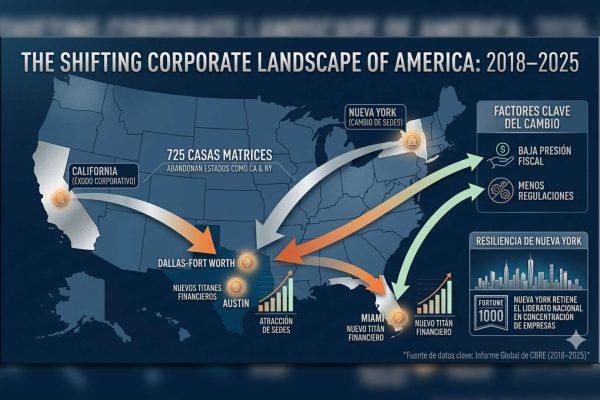
The corporate map of the United States is being redrawn, and Texas and Florida are at the center of the transformation. According to a comprehensive report from real estate giant CBRE, between 2018 and 2025, at least 725 major corporate headquarters moved out of high-cost states like California and New York, choosing instead to set up shop in the South. This isn't just a trend—it's a structural shift that's reshaping where jobs are created, how tax revenue flows, and what opportunities look like for Latino communities in these booming regions.
The Dallas-Fort Worth metroplex led the charge, securing 111 headquarters relocations during that period. Austin followed with 88, solidifying its reputation as a tech hub, while Houston added 31. In Florida, Miami leveraged its geographic and cultural ties to Latin America to attract companies from Los Angeles and San Francisco, rewriting the state's economic blueprint. For many Latino professionals in these cities, the influx of corporate headquarters means new job opportunities in tech, finance, and services—sectors where bilingual skills and cultural fluency are increasingly valued.
Why Companies Are Moving South
Corporate executives and CFOs cite a clear set of reasons: lower taxes, fewer regulations, and a lower cost of living. The Texas Business Association points to the state's predictable regulatory environment and tax-friendly policies as key draws for industries like tech, venture capital, and banking. Florida offers similar advantages, with no state income tax and a business climate that prioritizes growth. This migration has direct implications for Latino workers, who make up a significant portion of the labor force in both states. As companies expand, they're hiring locally, and that includes roles in management, logistics, and customer service that often require Spanish-language skills.
For context, the shift is part of a broader pattern. The Texas Leads U.S. Job Growth in 2026, Driven by Energy and Services Sectors story highlights how the state's economy continues to diversify, creating opportunities beyond oil and gas. Similarly, the US Housing Prices Drop in Florida and Beyond: What It Means for Latino Homeowners piece shows how these economic shifts affect real estate markets that many Latino families are navigating.
The Impact on California and New York
The exodus has taken a toll on the states losing headquarters. California saw 163 major corporate headquarters leave during the seven-year window, while New York experienced a steady drain of high-paying management positions. Yet, New York remains resilient: the CBRE data shows it still leads the nation in Fortune 1000 company concentration. That resilience matters for Latino communities in the tri-state area, where many families have deep roots. The challenge for these legacy states is to adapt their tax and regulatory frameworks to remain competitive without sacrificing the social programs that support diverse populations.
For Latino workers in Texas and Florida, the corporate migration brings both promise and pressure. In cities like Austin and Miami, rising housing costs are a concern, as noted in the US Housing Prices Drop in Florida and Beyond article. But the job growth is undeniable. The AI Boom Reshapes US Job Market: Blue-Collar Skills Become Gold for Latino Workers story underscores how these economic shifts are creating new pathways for skilled workers, many of whom are Latino.
As the corporate landscape continues to evolve, the choices made by companies in Dallas, Austin, and Miami will ripple through communities across the Americas. For Latino readers, understanding these trends is key to navigating the changing job market and seizing opportunities in a region that's increasingly becoming the heart of American business.