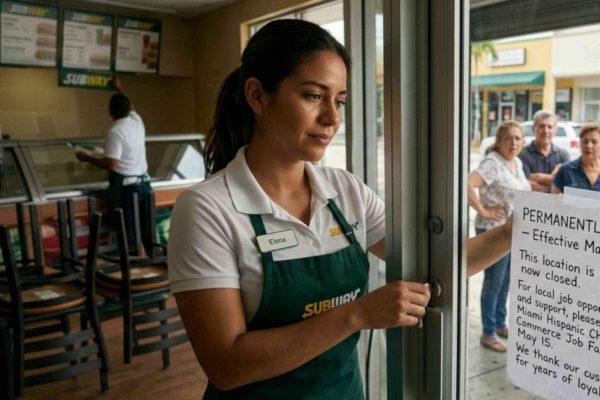
Over the past year, Subway has shuttered more than 700 locations across the United States, a contraction that has hit Latino workers and neighborhoods with particular force. In cities like Miami, Houston, and Los Angeles—where Latino employees make up over 35% of the restaurant workforce—the closures mean thousands of entry-level jobs have vanished, often serving as the first rung on the economic ladder for immigrant families.
The sandwich chain, once ubiquitous in strip malls and urban corners, now operates fewer than 19,000 stores nationwide. Yet the company reported record revenues of $688 million, doubling its net income through a strategy that prioritizes profitability over expansion. This disconnect between corporate success and community stability has left many questioning the cost of efficiency.
Economic Ripple Effects in Latino Enclaves
For many Latino workers, Subway jobs were more than just a paycheck—they were a gateway to the U.S. labor market. The loss of these positions has intensified competition for remaining jobs in the restaurant sector, while also stripping neighborhoods of affordable food options. Advocacy groups warn that when large chains pull out of Latino neighborhoods, social mobility is cut short, and the local economy suffers a double blow: fewer jobs and less access to inexpensive meals.
The situation echoes broader trends affecting service workers across the country. As the dollar's steep drop squeezes Latino families and businesses across the US, the loss of stable, entry-level employment adds another layer of financial strain.
Corporate Profits vs. Community Needs
Subway's financial turnaround—driven by store optimization and franchise restructuring—has come at a human cost. The company plans to open roughly 100 new locations by 2026, but that pace is far too slow to offset the losses. In the meantime, workers in cities like Houston and Los Angeles are scrambling for alternatives.
Local organizations recommend that affected employees attend job fairs and enroll in municipal training programs. The resilience of the Latino workforce remains a key asset, with many workers pivoting to other restaurant chains that are still growing. But the uncertainty lingers, especially for those who relied on Subway as their primary source of income.
Small Businesses Step Into the Void
On a more hopeful note, the closures have opened space for small local businesses and Hispanic-owned startups to fill the gap. In neighborhoods from Miami's Little Havana to East Los Angeles, entrepreneurs are launching independent eateries and catering services, offering both jobs and culturally familiar food. This grassroots response underscores a long-standing tradition of Latino entrepreneurship, even in the face of corporate retreat.
As Latino traditions keep us connected across generations in the U.S., the shift from big chains to local ventures may strengthen community bonds. Yet the transition is not seamless, and many families are feeling the pinch.
The Subway crisis serves as a stark reminder of the vulnerability of service workers and the need to diversify income sources within the most affected communities. For now, Latino workers in cities across the country are adapting, as they always have, but the road ahead remains uncertain.