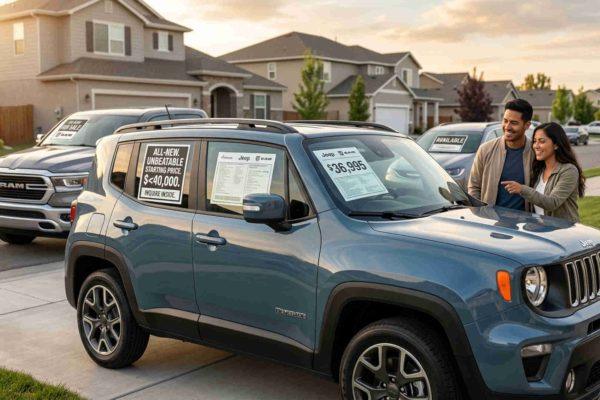
For many families across the United States, buying a new car has become a distant dream. With the average price hovering around $50,000, the middle class—including millions of Latino households—has been priced out of the market. But Stellantis, the multinational automaker behind brands like Jeep, Ram, and Chrysler, is betting big on a return to affordability.
The company has unveiled its FaSTLAne 2030 strategy, a $70 billion commitment to launch 11 new models in North America. Seven of those will carry a sticker price under $40,000, and some—like the upcoming Chrysler Arrow—will start as low as $25,000. That’s a price point that could make a real difference for families in cities like Los Angeles, Houston, or Chicago, where transportation costs eat up a large chunk of household budgets.
A Strategy Built on Value
Stellantis CEO Antonio Filosa presented the plan as a response to what he calls a “crisis of affordability.” The core of the strategy is a methodology called Value By Design, which focuses on streamlining manufacturing through new technology platforms. By cutting production costs without sacrificing quality, the company hopes to offer vehicles that compete on price without feeling cheap.
Among the models in the pipeline are the mid-size Chrysler Airflow SUV, the compact Chrysler Arrow and Arrow Cross, and two highly anticipated trucks: the Ram Dakota and the Ram Rampage. All are expected to stay under the $40,000 mark. For Latino families, who often rely on trucks for work or larger vehicles for extended family trips, this could mean significant savings—potentially hundreds of dollars less per month compared to current new-car payments.
This push comes at a time when the broader economy is squeezing working-class communities. As we’ve reported, California's housing market has hit a record $914K, pushing working-class Latinos out, and rental costs in cities like New York remain among the highest in the nation. Affordable transportation is more than a convenience—it’s a lifeline.
When Will These Cars Arrive?
Consumers will need to be patient. The rollout is scheduled to happen in phases between late 2026 and 2030. The first vehicles to benefit from the new architecture will be the Jeep Cherokee and the Jeep Recon EV, which will serve as testbeds for the cost-saving technologies. These models are expected to set the tone for the rest of the lineup.
Stellantis isn’t just reacting to market trends—it’s acknowledging a mistake. For years, automakers focused on high-margin SUVs and luxury trims, leaving the affordable segment neglected. This plan marks a shift back toward the democratization of car ownership. As Filosa put it, “We need to bring the middle class back into the new-car market.”
For Latino drivers, who represent a growing share of first-time car buyers in the U.S., this is a welcome development. Whether it’s a compact car for commuting in the Bronx or a pickup for work in the Central Valley, the promise of a reliable, affordable new vehicle could change the way families plan their finances.
In the meantime, those interested can keep an eye on early releases like the Jeep Recon EV, which will hit the market before the full lineup. And as the housing market continues to challenge affordability—check out our coverage of the NYC Affordable Housing Lottery Overhaul: What Bronx Latinos Need to Know—having access to cheaper transportation could help ease the overall cost of living.
Stellantis’s plan is ambitious, but it’s also a bet that the American dream of owning a new car isn’t dead. For millions of families, it might just be coming back within reach.